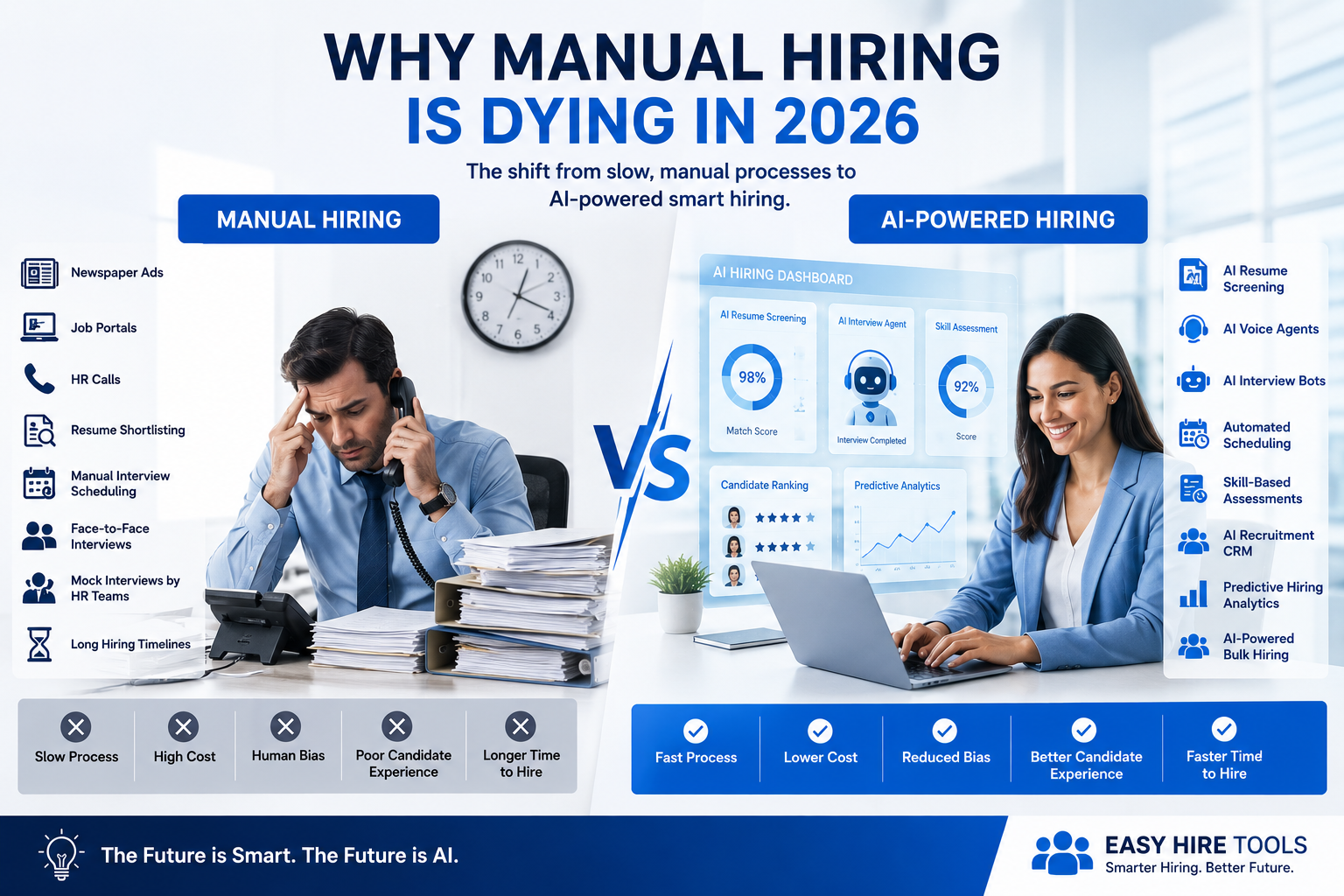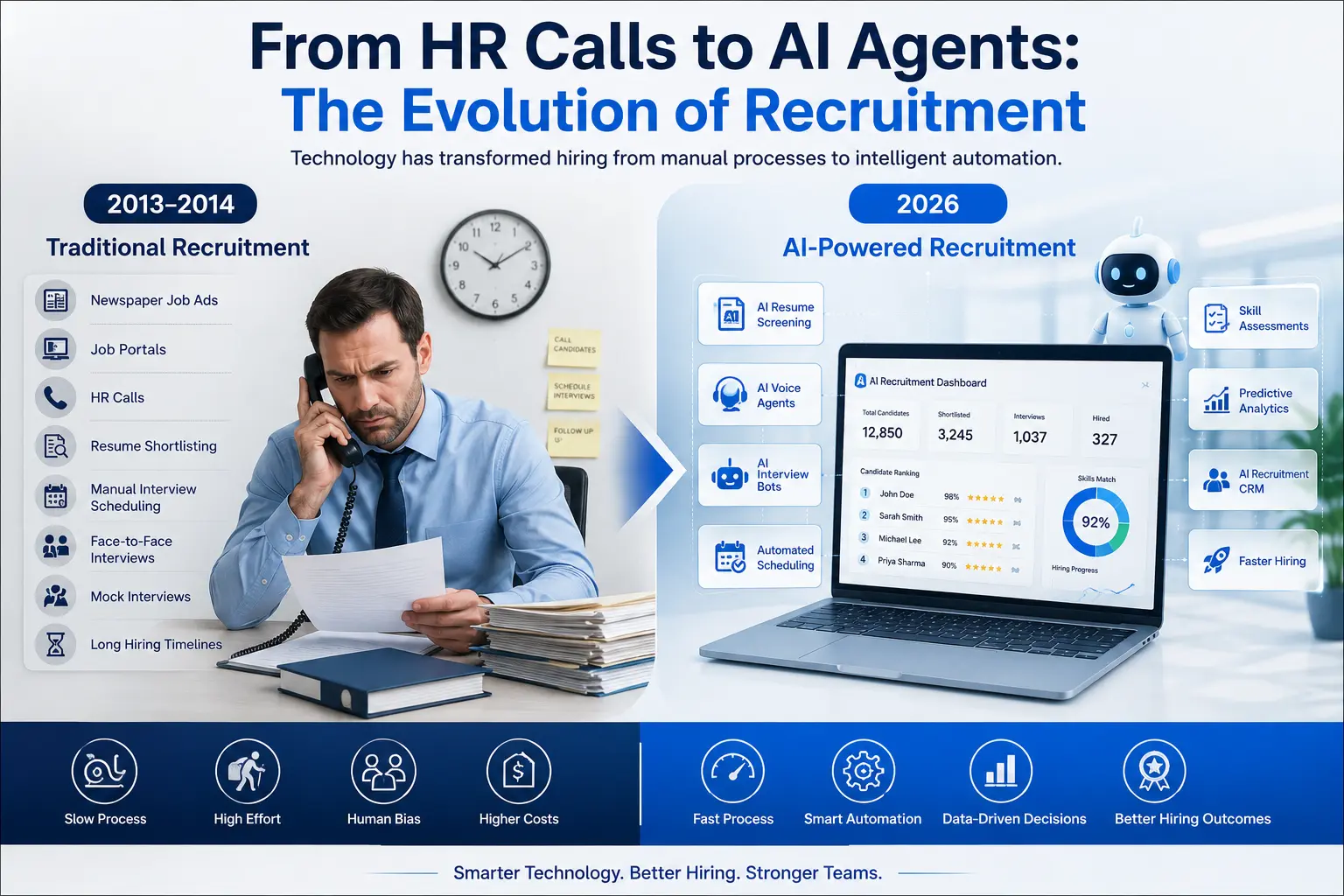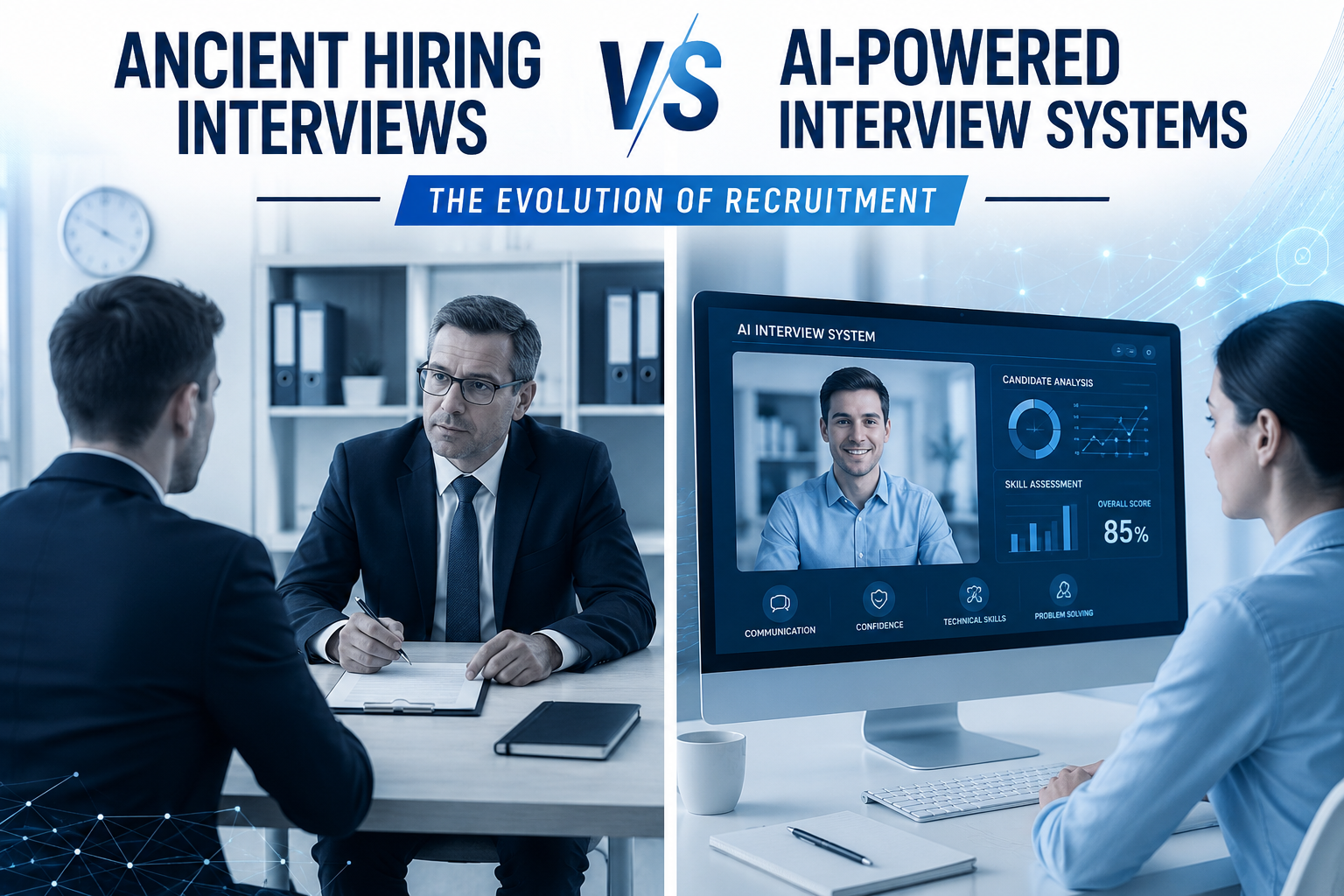
Imagine stepping into an office in 2012.
A candidate walks into a conference room holding a printed resume. The HR manager sits across the table with a notebook, a stack of resumes, and a list of generic interview questions. The interview begins with the same question asked hundreds of times before:
"Tell me about yourself."
The candidate speaks. The recruiter takes notes. Decisions are influenced by memory, personal impressions, and sometimes unconscious bias. After the interview, the HR team manually compares candidates, schedules follow-ups, and spends days discussing who might be the right fit.
Fast forward to 2026.
A candidate applies online. Within seconds, an AI-powered interview system analyzes skills, experience, communication abilities, and job compatibility. AI conducts initial screening interviews, generates detailed candidate reports, and helps recruiters make data-driven decisions.
The hiring world has transformed dramatically.
This shift from traditional hiring methods to AI-powered interview systems is not just a technological upgrade—it is a complete revolution in how organizations discover and evaluate talent.
The Era of Ancient Hiring Interviews
Before artificial intelligence entered recruitment, hiring depended almost entirely on human effort.
Recruiters manually reviewed resumes, scheduled interviews through endless emails, and relied on subjective observations to assess candidates.
While these methods worked for decades, they created numerous challenges.
Time-Consuming Recruitment Process
Traditional interviews required significant time investments.
Recruiters often spent hours reviewing applications, coordinating schedules, conducting interviews, and documenting feedback.
For organizations receiving hundreds of applications, the process became overwhelming.
A single position could remain open for weeks or even months.
Human Bias in Decision-Making
Even experienced recruiters can be influenced by unconscious biases.
Factors such as appearance, educational background, communication style, or personal similarities sometimes affected hiring decisions.
As a result, qualified candidates were occasionally overlooked despite having the necessary skills.
Limited Candidate Evaluation
Traditional interviews provided only a snapshot of a candidate's abilities.
Many hiring decisions depended on a few conversations that might not accurately represent a person's true potential.
This often led to mismatches between candidates and job roles.
Difficulty in Bulk Hiring
Industries such as retail, customer service, healthcare, and manufacturing frequently require large-scale recruitment.
Using traditional hiring methods, screening thousands of candidates manually became nearly impossible without expanding HR teams.
The Rise of AI-Powered Interview Systems
As businesses embraced digital transformation, recruitment also evolved.
AI-powered interview systems emerged to solve the inefficiencies of traditional hiring.
These systems combine artificial intelligence, machine learning, natural language processing, and data analytics to automate and enhance recruitment processes.
Today, organizations worldwide use AI recruitment tools to identify top talent faster and more accurately.
How AI-Powered Interview Systems Work
Modern AI interview systems analyze candidate information through multiple stages.
Automated Resume Screening
AI scans resumes within seconds and identifies candidates who match job requirements.
Instead of manually reviewing hundreds of applications, recruiters receive a shortlist of qualified candidates immediately.
AI Video Interviews
Candidates participate in structured interviews where AI evaluates responses based on predefined criteria.
The system analyzes communication skills, technical knowledge, and job-specific competencies.
Intelligent Candidate Ranking
AI-powered recruitment platforms compare candidates using objective data points.
This helps recruiters identify top performers without relying solely on subjective impressions.
Predictive Hiring Analytics
One of the most powerful features of AI hiring software is predictive analysis.
AI can assess patterns from successful employees and predict which candidates are most likely to excel in a role.
This reduces hiring risks and improves employee retention.
Traditional Hiring vs AI-Powered Interview Systems
Speed
Traditional hiring methods often require weeks of screening and interviews.
AI interview systems can evaluate thousands of candidates within hours.
Consistency
Human interviewers may ask different questions or evaluate candidates differently.
AI ensures every applicant receives a consistent assessment process.
Accuracy
Recruiters can miss important details when reviewing large volumes of applications.
AI-powered recruitment tools analyze vast amounts of data with remarkable precision.
Cost Efficiency
Hiring teams spend significant resources on manual recruitment.
Recruitment automation reduces administrative work, allowing HR professionals to focus on strategic hiring decisions.
Scalability
Traditional interviews struggle with high-volume recruitment.
AI hiring software easily scales to manage thousands of applicants simultaneously.
A Story of Two Companies
Consider two growing technology companies.
Company A continues using traditional hiring methods.
Recruiters manually screen resumes, conduct phone interviews, and spend weeks coordinating schedules.
The average hiring cycle takes 45 days.
Company B adopts AI-powered interview systems.
Applications are screened automatically. Initial interviews are conducted using AI. Candidate reports are generated instantly.
The average hiring cycle drops to 12 days.
While Company A struggles to fill vacancies, Company B secures top talent before competitors even complete their first round of interviews.
This is the competitive advantage AI-powered recruitment creates in today's fast-moving job market.
Benefits of AI Interview Systems for Recruiters
Improved Productivity
Recruiters spend less time on repetitive tasks and more time building relationships with candidates.
Better Hiring Decisions
Data-driven insights support objective and informed decision-making.
Enhanced Candidate Experience
Candidates receive faster responses and a smoother recruitment journey.
Reduced Hiring Costs
Automation significantly lowers operational recruitment expenses.
Higher Quality Hires
AI helps identify candidates whose skills align closely with organizational requirements.
Benefits for Job Seekers
AI-powered interview systems are not only beneficial for employers.
Candidates also gain several advantages.
Faster Application Processing
Applicants receive updates more quickly than in traditional recruitment cycles.
Fair Evaluation
AI evaluates candidates based on qualifications and competencies rather than personal factors.
Convenient Interview Scheduling
Automated interview systems offer flexibility and reduce scheduling conflicts.
Transparent Recruitment Process
Many AI recruitment platforms provide structured assessments that improve consistency and fairness.
Challenges of AI-Powered Interview Systems
Despite their advantages, AI systems are not perfect.
Organizations must address several concerns.
Algorithm Bias
Poorly designed AI models can inherit biases from historical data.
Companies must continuously monitor and improve algorithms.
Privacy Concerns
Candidate data must be handled responsibly and securely.
Human Touch
Recruitment remains a people-focused process.
AI should support recruiters rather than completely replace human interaction.
The most successful organizations combine AI efficiency with human judgment.
The Future of Hiring
The future of hiring is neither fully human nor fully automated.
Instead, it is a powerful collaboration between recruiters and intelligent technology.
AI-powered interview systems will continue evolving with advanced predictive analytics, skill assessments, behavioral evaluations, and real-time candidate insights.
Organizations that embrace modern recruitment technology will gain a significant advantage in attracting and retaining top talent.
Meanwhile, companies that rely solely on ancient hiring interviews may struggle to keep pace with changing workforce expectations.
Conclusion
The journey from ancient hiring interviews to AI-powered interview systems represents one of the most significant transformations in modern recruitment.
Traditional hiring methods laid the foundation for talent acquisition, but they are increasingly challenged by speed, scale, and efficiency demands.
AI interview systems provide faster screening, improved accuracy, better candidate experiences, and data-driven decision-making.
Rather than replacing recruiters, AI empowers them to focus on what matters most—building meaningful connections and identifying exceptional talent.
As recruitment continues to evolve, businesses that adopt AI-powered recruitment solutions will be better positioned to compete in an increasingly talent-driven world.
The question is no longer whether organizations should embrace AI hiring software.
The real question is how quickly they can adapt before their competitors do.