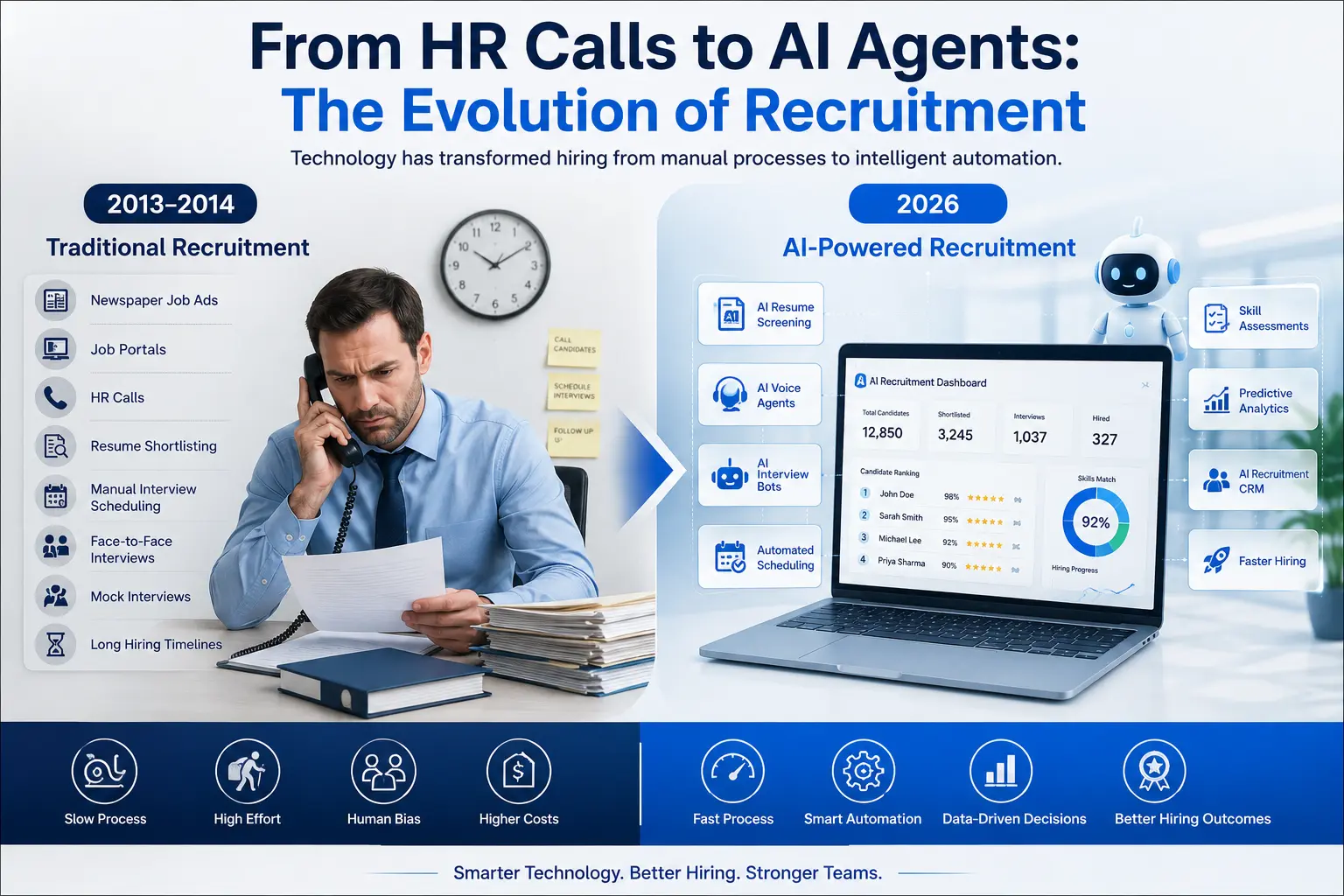
Back in 2013 and 2014, recruitment looked completely different from what we see today. HR teams spent long hours reviewing printed resumes, making endless phone calls, scheduling interviews manually, and coordinating with department heads through emails and spreadsheets. Hiring was slow, time-consuming, and heavily dependent on human effort.
A candidate searching for a job during that time often waited weeks just to receive a callback. Companies posted job advertisements in newspapers, uploaded openings on job portals, and depended on recruiters to screen candidates one by one. Interviews were mostly conducted face-to-face, and mock interviews were handled manually by HR teams. Recruitment was personal, but it was also inefficient.
Fast forward to 2026, and the recruitment landscape has transformed dramatically. Artificial intelligence, automation, and AI agents are redefining how companies hire talent. Today, businesses can screen thousands of resumes within minutes, conduct AI-powered interviews, automate candidate communication, and predict hiring success using data-driven analytics.
The journey from HR calls to AI agents represents one of the biggest transformations in the modern workplace. Companies are no longer relying only on traditional recruitment methods. Instead, they are embracing AI recruitment tools that improve hiring speed, reduce costs, and enhance candidate experience.
In this blog, we will explore how recruitment evolved from manual hiring processes in 2013 to intelligent AI hiring systems in 2026 and why businesses across India and the USA are rapidly adopting AI-powered recruitment solutions.
Evolution of Hiring: 2013 vs 2026
Recruitment in 2013–2014: The Human-Driven Era
In 2013, hiring was primarily manual. Most companies depended on HR professionals to manage every stage of the recruitment process.
Newspaper Job Advertisements
Many businesses still advertised job openings through newspapers. Weekend employment sections were filled with vacancies for engineers, sales executives, accountants, and customer support roles. Candidates had to either email resumes or physically submit applications.
This process consumed both time and resources.
Job Portals Became Popular
Platforms like job portals started becoming mainstream, allowing recruiters to upload openings online. However, recruiters still had to manually review hundreds of resumes.
The recruitment workflow looked something like this:
- Job posted online
- Candidates applied manually
- HR downloaded resumes
- Recruiters shortlisted candidates
- HR called applicants individually
- Interviews were scheduled manually
Even after technology entered recruitment, the process still relied heavily on human coordination.
HR Phone Calls and Screening
One of the most common recruitment methods in 2014 was HR telephonic screening.
Recruiters spent hours every day:
- Calling candidates
- Explaining job descriptions
- Checking communication skills
- Discussing salary expectations
- Scheduling interviews
For large companies hiring in bulk, this became exhausting.
Manual Interview Scheduling
Scheduling interviews was another challenge. HR teams coordinated with:
- Hiring managers
- Department heads
- Interview panels
- Candidates
Rescheduling interviews due to availability issues was extremely common.
Face-to-Face Interviews
Most interviews happened physically. Candidates traveled long distances for interviews, especially in metro cities like Mumbai, Bangalore, Delhi, Hyderabad, and Pune.
This increased:
- Hiring costs
- Candidate drop-offs
- Time-to-hire
Mock Interviews and Assessment Rounds
HR teams often conducted mock interviews before final rounds to evaluate confidence, technical knowledge, and personality.
The entire hiring process could take anywhere from:
- 2 weeks
- 1 month
- Sometimes even 3 months
For businesses growing rapidly, this hiring speed became a major problem.
Problems with Traditional Recruitment
Although traditional hiring methods worked for many years, they had several limitations.
Slow Hiring Process
Recruiters manually reviewing resumes slowed down hiring significantly. A single job posting could receive thousands of applications.
Filtering candidates manually created delays.
High Recruitment Costs
Traditional recruitment involved:
- HR salaries
- Interview coordination
- Office interview arrangements
- Travel reimbursements
- Recruitment agency fees
Hiring became expensive, especially for startups.
Human Bias in Recruitment
Manual hiring often involved unconscious bias based on:
- College background
- Resume formatting
- Communication style
- Personal assumptions
This affected hiring quality and diversity.
Poor Candidate Experience
Candidates frequently faced:
- Delayed responses
- Missed interview calls
- Long waiting periods
- Lack of communication
Many talented professionals lost interest during the process.
Difficulty in Bulk Hiring
Industries like:
- BPO
- IT services
- Manufacturing
- Retail
- Logistics
needed large-scale hiring quickly. Traditional methods struggled to manage bulk recruitment efficiently.
This is where AI recruitment started changing the industry.
Rise of AI Recruitment
By the early 2020s, companies began adopting automation tools to improve recruitment efficiency. By 2026, AI recruitment became one of the most important innovations in HR technology.
Modern businesses now use intelligent systems that automate repetitive hiring tasks and improve decision-making.
What is AI Recruitment?
AI recruitment refers to the use of artificial intelligence and automation technologies to streamline hiring processes.
AI-powered recruitment tools can:
- Screen resumes automatically
- Rank candidates
- Conduct interviews
- Schedule meetings
- Analyze candidate behavior
- Predict hiring success
AI is not replacing recruiters completely. Instead, it helps recruiters work smarter and faster.
How AI Resume Screening Changed Hiring
One of the biggest breakthroughs in recruitment automation is AI resume screening.
Earlier, HR teams manually reviewed resumes line by line.
Today, AI hiring software can analyze:
- Skills
- Experience
- Certifications
- Keywords
- Industry relevance
- Job matching scores
within seconds.
Benefits of AI Resume Screening
Faster Shortlisting
AI can scan thousands of resumes instantly, reducing hiring time significantly.
Better Candidate Matching
Advanced algorithms identify candidates whose skills align closely with job requirements.
Reduced Human Error
Automation minimizes the risk of overlooking qualified candidates.
Improved Recruitment Efficiency
Recruiters can focus on strategic hiring rather than repetitive administrative tasks.
This is one reason why AI recruitment tools are becoming essential for modern companies.
How AI Agents Conduct Interviews
The biggest transformation in 2026 recruitment is the rise of AI interview agents.
Today, AI voice agents and AI interview bots can conduct initial screening interviews without human intervention.
AI Voice Interviews
AI voice agents interact with candidates using natural conversations.
They can:
- Ask predefined questions
- Evaluate communication skills
- Analyze response quality
- Detect confidence levels
- Record interview summaries
Candidates can complete interviews anytime without waiting for HR availability.
AI Video Interview Bots
Modern AI interview platforms also conduct video interviews.
These systems analyze:
- Facial expressions
- Speech patterns
- Response clarity
- Technical answers
- Behavioral indicators
This creates a more data-driven hiring process.
Automated Candidate Scoring
After interviews, AI systems generate candidate scores based on:
- Technical fit
- Communication
- Experience
- Problem-solving ability
- Behavioral analysis
Recruiters receive ranked candidate lists instantly.
This saves massive amounts of time for HR teams.
AI Recruitment CRM and Automation
Modern recruitment is no longer managed using spreadsheets alone.
AI recruitment CRM systems now help companies manage the entire hiring pipeline efficiently.
What AI Recruitment CRM Can Do
Candidate Tracking
Track applications from initial contact to final onboarding.
Automated Follow-Ups
AI systems send:
- Interview reminders
- Status updates
- Rejection emails
- Offer letters
automatically.
Talent Pool Management
Recruiters can build and manage talent databases for future hiring needs.
Smart Hiring Analytics
Recruitment dashboards provide insights into:
- Hiring performance
- Source effectiveness
- Candidate conversion rates
- Time-to-hire metrics
This helps businesses make smarter hiring decisions.
Predictive Hiring Analytics in 2026
One of the most powerful innovations in AI recruitment is predictive hiring analytics.
AI systems now analyze historical hiring data to predict:
- Candidate success probability
- Employee retention likelihood
- Cultural fit
- Performance potential
This helps companies reduce bad hires.
Why Predictive Hiring Matters
A wrong hire can cost businesses:
- Money
- Productivity
- Team performance
- Training resources
Predictive analytics improves hiring accuracy significantly.
Companies using AI hiring tools are now making more confident recruitment decisions.
AI-Powered Bulk Hiring
Bulk hiring was one of the biggest challenges in traditional recruitment.
Today, AI-powered hiring platforms can manage large-scale recruitment campaigns efficiently.
Industries benefiting from AI bulk hiring include:
- Customer support
- IT services
- Delivery companies
- Retail chains
- Manufacturing plants
- Healthcare
How AI Simplifies Bulk Hiring
Automated Screening
Thousands of resumes are analyzed instantly.
AI Chatbots
Candidates receive immediate responses and interview instructions.
Skill Assessments
AI systems evaluate technical and behavioral skills automatically.
Interview Automation
AI agents conduct initial interview rounds without recruiter involvement.
This dramatically reduces hiring time.
Skill-Based AI Assessments
Modern companies are focusing more on skills rather than degrees alone.
AI-powered assessment platforms evaluate:
- Coding skills
- Communication ability
- Aptitude
- Sales skills
- Problem-solving
- Domain expertise
This creates a more practical hiring process.
Why Skill-Based Hiring is Growing
Many companies realized that:
- Degrees do not always guarantee skills
- Practical ability matters more
- Traditional resumes can be misleading
AI assessments help companies identify genuine talent.
Why Startups and Enterprises Are Adopting AI Recruitment
Both startups and large enterprises are investing heavily in AI hiring solutions.
Benefits for Startups
Startups need:
- Faster hiring
- Lower recruitment costs
- Better productivity
- Scalable hiring systems
AI recruitment tools help startups compete with larger companies.
Benefits for Enterprises
Large organizations benefit from:
- High-volume recruitment
- Global hiring management
- Consistent candidate evaluation
- Workforce analytics
AI recruitment creates operational efficiency at scale.
AI Recruitment Trends in India and the USA
The adoption of AI recruitment is growing rapidly in both India and the USA.
India's Growing AI Hiring Market
Indian businesses are increasingly using:
- AI hiring software
- Recruitment automation
- AI voice interviews
- Bulk hiring solutions
especially in:
- IT
- BPO
- Startups
- Ecommerce
- Staffing agencies
USA's Advanced AI Recruitment Ecosystem
Companies in the USA are investing heavily in:
- Predictive hiring
- AI talent intelligence
- Automated recruitment platforms
- AI-based workforce analytics
Global competition is pushing companies toward smarter hiring technologies.
Future of Recruitment in 2030
The future of recruitment will become even more AI-driven.
By 2030, we may see:
- Fully autonomous hiring systems
- AI-generated job descriptions
- Real-time candidate matching
- Virtual reality interviews
- AI career coaching
- Hyper-personalized recruitment journeys
Recruiters will focus more on:
- Human relationships
- Strategic hiring decisions
- Employer branding
- Workforce planning
AI will handle repetitive tasks while humans focus on leadership and culture.
Why Easy Hire Tools is the Future of Hiring
As recruitment evolves, businesses need smarter hiring solutions that combine automation, intelligence, and user-friendly technology.
Easy Hire Tools is designed to help companies modernize recruitment with advanced AI-powered hiring capabilities.
Key Advantages of Easy Hire Tools
AI-Powered Resume Screening
Shortlist qualified candidates faster using intelligent matching systems.
AI Interview Automation
Conduct scalable candidate interviews using AI voice agents and automated interview workflows.
Recruitment CRM
Manage hiring pipelines efficiently with centralized candidate tracking.
Bulk Hiring Support
Handle large recruitment campaigns without increasing HR workload.
Skill Assessment Integration
Evaluate candidates based on practical abilities and role-specific competencies.
Faster Hiring Decisions
Reduce time-to-hire while improving recruitment quality.
Easy Hire Tools helps startups, enterprises, staffing agencies, and recruiters build modern hiring systems for the future workforce.
Final Thoughts
The recruitment industry has experienced an incredible transformation over the last decade.
In 2013, hiring depended heavily on human effort, manual coordination, and time-consuming processes. HR professionals spent countless hours calling candidates, scheduling interviews, reviewing resumes, and managing recruitment workflows manually.
In 2026, AI recruitment has completely changed the hiring experience.
Today, AI agents can screen resumes, conduct interviews, automate communication, analyze candidate performance, and help businesses hire smarter and faster than ever before.
The shift from HR calls to AI agents is not just a technology trend — it represents the future of work itself.
Companies that adopt AI hiring tools today will gain a significant advantage in attracting top talent, reducing hiring costs, and building stronger teams for the future.
As businesses continue evolving, AI-powered recruitment platforms like Easy Hire Tools will play a major role in shaping the next generation of hiring.
FAQs
1. What is AI recruitment?
AI recruitment uses artificial intelligence and automation technologies to streamline hiring processes such as resume screening, interviews, candidate scoring, and scheduling.
2. How do AI interview bots work?
AI interview bots ask predefined questions, analyze candidate responses, and generate performance insights automatically.
3. Can AI replace human recruiters completely?
No. AI helps automate repetitive tasks, but human recruiters are still essential for relationship-building and strategic hiring decisions.
4. What are the benefits of AI recruitment tools?
AI recruitment tools improve hiring speed, reduce costs, automate workflows, and enhance candidate screening accuracy.
5. How does AI resume screening work?
AI systems scan resumes for skills, experience, keywords, and job relevance to identify suitable candidates quickly.
6. Why are companies using AI hiring software in 2026?
Companies use AI hiring software to improve recruitment efficiency, reduce manual work, and make data-driven hiring decisions.
7. What industries benefit most from AI recruitment?
Industries such as IT, BPO, retail, healthcare, logistics, and staffing benefit significantly from AI-powered hiring.
8. What is predictive hiring analytics?
Predictive hiring analytics uses historical data and AI algorithms to predict candidate success and retention potential.
9. How does AI help in bulk hiring?
AI automates resume screening, interview scheduling, candidate communication, and assessments for large-scale hiring campaigns.
10. Is AI recruitment suitable for startups?
Yes. Startups benefit from faster hiring, lower costs, and scalable recruitment automation using AI tools.
11. What is an AI recruitment CRM?
An AI recruitment CRM helps companies manage candidate pipelines, automate communication, and track recruitment performance.
12. What is the future of recruitment after AI?
The future of recruitment will involve more automation, predictive hiring, AI agents, virtual interviews, and skill-based hiring systems.