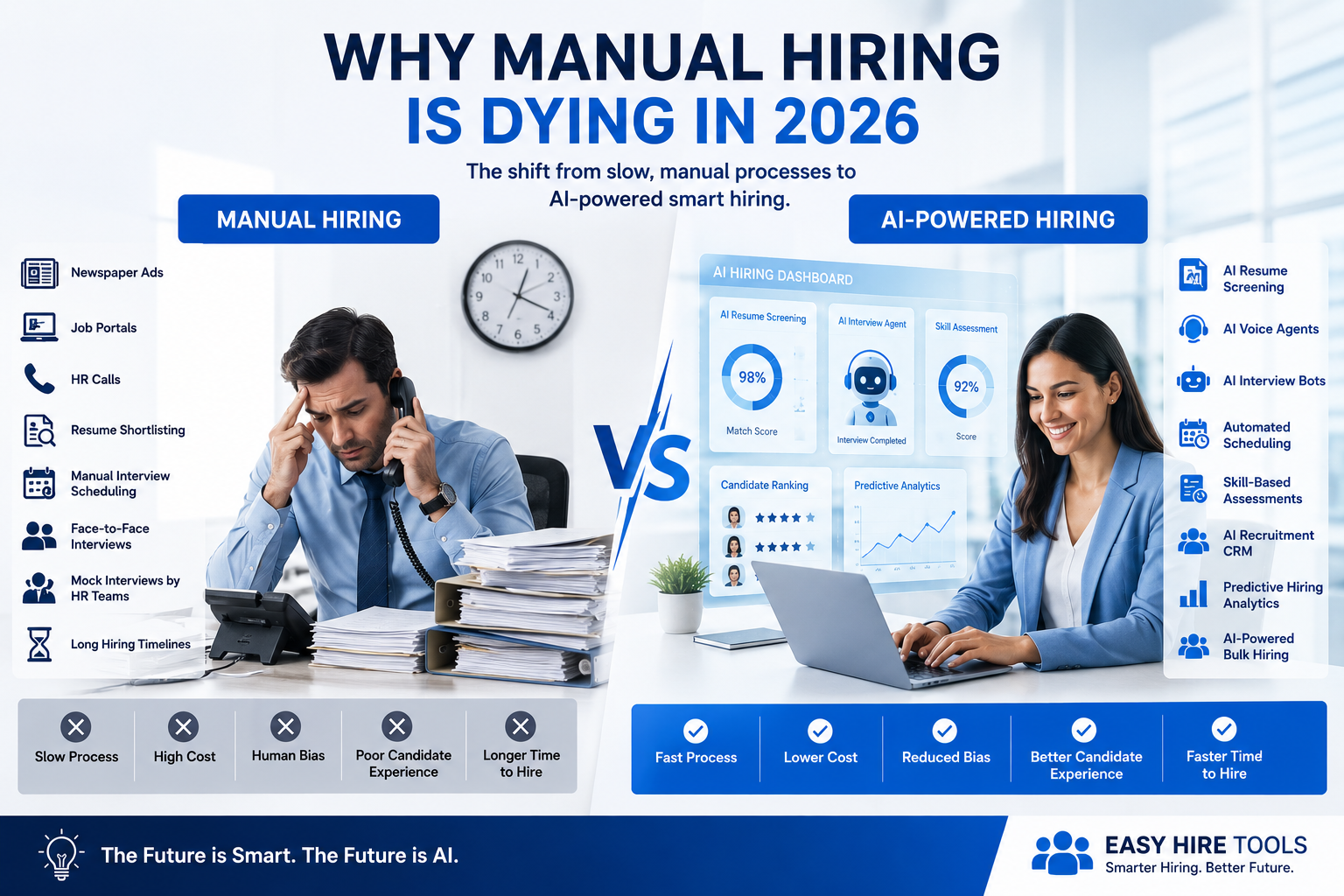
There was a time when recruitment was entirely driven by human effort. Hiring managers sat in crowded offices surrounded by stacks of resumes, ringing telephones, interview schedules, and endless spreadsheets. Recruiters spent their mornings posting job advertisements in newspapers and their evenings making follow-up calls to candidates.
Back then, finding the right employee was a slow and exhausting process.
A single hiring cycle could take weeks or even months. Candidates waited anxiously for callbacks while HR teams manually reviewed applications one by one. Interviews were scheduled through countless emails and phone calls. Face-to-face interviews required travel, coordination, and significant time investment from both companies and applicants.
This traditional recruitment system worked for decades because there was no better alternative.
But the hiring world has changed dramatically.
In 2026, companies no longer depend entirely on manual recruitment methods. Artificial intelligence, automation, and AI hiring tools have completely transformed how businesses attract, screen, interview, and hire talent.
Today, AI voice agents can conduct interviews, AI systems can shortlist thousands of resumes within minutes, and recruitment automation platforms can manage hiring pipelines without constant human involvement.
The shift from manual hiring to AI-powered recruitment is not just a technological upgrade — it is a complete transformation of the hiring industry.
Businesses across India and the USA are now realizing that traditional hiring methods are too slow, too expensive, and too inefficient for the modern workforce.
This is exactly why manual hiring is dying in 2026.
In this blog, we will explore the evolution of recruitment from ancient hiring methods to modern AI-powered recruitment systems and understand why AI hiring tools are becoming the future of recruitment.
Evolution of Hiring: Ancient vs Latest Recruitment Systems
Ancient Recruitment Methods: The Human-Driven Hiring Era
Before digital recruitment became mainstream, hiring was completely manual.
Employers relied on newspaper advertisements, local references, walk-in interviews, and personal networks to recruit employees.
Recruitment was based more on relationships and human judgment than technology.
Newspaper Job Advertisements
For many years, newspaper classifieds were one of the biggest sources of recruitment.
Companies published job openings in:
- Local newspapers
- Employment magazines
- Industry publications
Because newspaper space was expensive, job descriptions were often short and limited.
A traditional newspaper hiring ad included:
- Job title
- Experience required
- Qualification
- Contact number
- Office address
There was very little detail about company culture, skills, or growth opportunities. This made hiring less effective.
Traditional Recruitment Processes Companies Used
HR Phone Calls
One of the most time-consuming parts of traditional recruitment was telephonic screening.
HR professionals spent hours:
- Calling candidates
- Explaining job roles
- Discussing salary expectations
- Evaluating communication skills
- Scheduling interviews
For companies hiring in bulk, these calls became repetitive and exhausting. Recruiters often struggled to manage hundreds of candidates simultaneously.
Manual Resume Shortlisting
Recruiters manually reviewed every resume to identify suitable candidates. This process created several challenges:
- Human error
- Candidate bias
- Slow response times
- Missed opportunities
A single job opening could attract thousands of resumes, making the screening process extremely difficult.
Manual Interview Scheduling
Scheduling interviews involved continuous coordination between candidates, HR teams, hiring managers, and department heads.
Rescheduling interviews was common due to time conflicts, availability issues, and travel delays. This slowed down the entire recruitment cycle significantly.
Long Hiring Timelines
Traditional recruitment processes were extremely slow. Hiring could take 2 weeks, 1 month, or sometimes several months. This created major problems for fast-growing companies that needed talent quickly.
Problems with Traditional Recruitment
Although manual recruitment worked in the past, modern businesses now face challenges that traditional hiring cannot solve efficiently.
Slow Hiring Speed
Manual recruitment takes too much time. In today's competitive market, companies cannot afford long hiring cycles because top candidates often accept offers quickly.
Slow recruitment leads to:
- Talent loss
- Project delays
- Reduced productivity
High Recruitment Costs
Traditional recruitment involves:
- HR manpower
- Recruitment agencies
- Office interview setups
- Travel reimbursements
- Administrative work
These costs increase significantly for companies hiring at scale.
Human Bias in Hiring
Manual recruitment decisions can be influenced by unconscious bias. Factors such as resume formatting, educational background, communication style, and personal assumptions can impact candidate selection unfairly.
AI recruitment tools help reduce this bias using data-driven evaluation methods.
Difficulty in Bulk Hiring
Industries like IT services, BPO, ecommerce, logistics, healthcare, and retail require large-scale recruitment regularly.
Traditional recruitment struggles to manage high-volume hiring efficiently. This is one of the biggest reasons why manual hiring is dying in 2026.
Rise of AI Recruitment
AI recruitment has transformed how companies hire employees. Modern businesses now use intelligent systems that automate repetitive hiring tasks and improve recruitment accuracy.
What is AI Recruitment?
AI recruitment refers to the use of artificial intelligence, automation, machine learning, and data analytics to streamline the hiring process.
AI hiring systems can:
- Screen resumes
- Rank candidates
- Conduct interviews
- Schedule meetings
- Analyze skills
- Predict hiring success
This helps companies hire faster and smarter.
How AI Resume Screening Changed Recruitment
AI resume screening is one of the biggest innovations in modern recruitment. Earlier, HR teams manually reviewed resumes for hours. Today, AI-powered recruitment tools can analyze thousands of resumes within minutes.
Benefits of AI Resume Screening
Faster Hiring: Recruiters save countless hours by automating resume analysis.
Better Candidate Matching: AI identifies candidates whose qualifications closely match job requirements.
Reduced Human Error: Automation minimizes the chances of missing qualified applicants.
Improved Recruitment Productivity: Recruiters can focus on strategic hiring decisions instead of repetitive administrative tasks.
How AI Agents Conduct Interviews
One of the most exciting developments in 2026 recruitment is the rise of AI interview agents. AI voice agents and AI interview bots can now conduct initial interviews automatically.
AI Voice Agents
AI voice agents interact with candidates naturally using conversational AI. These systems can:
- Ask interview questions
- Analyze responses
- Evaluate communication skills
- Record interview summaries
- Generate candidate scores
Candidates can complete interviews anytime without depending on recruiter availability.
AI-Powered Bulk Hiring
Bulk recruitment is one of the biggest areas where AI recruitment tools outperform traditional hiring. Industries using AI-powered bulk hiring include BPO, ecommerce, manufacturing, retail, customer support, and logistics.
How AI Simplifies Bulk Hiring
Automated Resume Screening: Thousands of applications can be processed instantly.
AI Chatbots: Candidates receive immediate responses and interview updates.
Skill Assessments: AI systems conduct automated technical and behavioral assessments.
Automated Interview Scheduling: Interviews are scheduled automatically without HR coordination. This significantly reduces hiring timelines.
Benefits of AI Hiring Tools
Faster Recruitment: AI reduces time-to-hire dramatically.
Lower Hiring Costs: Automation reduces dependency on large recruitment teams.
Better Candidate Experience: Candidates receive faster updates and smoother interview experiences.
Improved Hiring Accuracy: AI uses data-driven insights to identify better candidates.
Scalable Recruitment: Businesses can handle large-scale hiring efficiently. These advantages explain why manual hiring is dying in 2026.
Why Startups and Enterprises Are Adopting AI Recruitment
Startups Need Faster Hiring
Startups operate in highly competitive environments. They need quick hiring, cost-effective recruitment, and scalable hiring systems.
AI recruitment tools help startups grow faster.
Enterprises Need Large-Scale Recruitment Automation
Large companies manage thousands of applications every month. AI helps enterprises improve hiring efficiency, standardize recruitment, reduce operational workload, and enhance hiring quality.
This is why AI recruitment adoption is increasing globally.
Future of Recruitment in 2030
Recruitment will become even more intelligent in the future. By 2030, we may see:
- Fully autonomous hiring systems
- AI-generated hiring strategies
- Virtual reality interviews
- Real-time skill matching
- AI career assistants
- Hyper-personalized recruitment experiences
Recruiters will focus more on leadership hiring, relationship building, workforce strategy, and employer branding. AI will manage repetitive recruitment operations.
Why Easy Hire Tools is the Future of Hiring
As businesses modernize recruitment, they need intelligent hiring platforms that combine automation, analytics, and user-friendly technology.
Easy Hire Tools helps businesses streamline recruitment using advanced AI-powered solutions.
Key Features of Easy Hire Tools
AI Resume Screening: Shortlist qualified candidates instantly.
AI Interview Automation: Conduct scalable interviews using AI voice agents and AI interview bots.
Recruitment CRM: Manage hiring pipelines efficiently.
Bulk Hiring Solutions: Handle large recruitment campaigns effortlessly.
Skill Assessment Integration: Evaluate candidates using practical skill-based assessments.
Recruitment Analytics: Make smarter hiring decisions using data-driven insights.
Easy Hire Tools empowers startups, enterprises, staffing agencies, and HR teams to build future-ready recruitment systems.
Final Thoughts
The recruitment industry is evolving faster than ever before.
Traditional hiring methods that once dominated recruitment are now becoming outdated. Manual resume screening, endless HR calls, interview coordination, and slow hiring processes can no longer meet the demands of modern businesses.
In 2026, companies need faster hiring, better candidate experiences, lower recruitment costs, and smarter hiring decisions.
AI recruitment tools are solving these challenges through automation, intelligence, and data-driven hiring systems.
The shift from manual hiring to AI-powered recruitment is not just a trend — it is the future of work.
Businesses that embrace AI hiring technology today will gain a competitive advantage tomorrow. And platforms like Easy Hire Tools are leading this transformation by helping companies hire smarter, faster, and more efficiently.
FAQs
1. Why is manual hiring dying in 2026?
Manual hiring is becoming outdated because it is slow, expensive, and inefficient compared to AI-powered recruitment systems.
2. What is AI recruitment?
AI recruitment uses artificial intelligence and automation tools to streamline hiring processes like screening, interviews, and candidate evaluation.
3. How does AI resume screening work?
AI systems analyze resumes based on skills, experience, certifications, and job relevance to identify suitable candidates quickly.
4. What are AI interview bots?
AI interview bots are automated systems that conduct candidate interviews using conversational AI technology.
5. Can AI replace human recruiters?
AI helps automate repetitive recruitment tasks, but human recruiters are still essential for strategic hiring and relationship management.
6. What are the benefits of AI hiring tools?
AI hiring tools improve hiring speed, reduce costs, automate workflows, and enhance recruitment accuracy.
7. How do AI voice agents help recruitment?
AI voice agents conduct automated interviews, evaluate communication skills, and provide interview summaries.
8. What industries use AI recruitment tools?
Industries such as IT, BPO, retail, healthcare, ecommerce, logistics, and staffing use AI recruitment extensively.
9. What is predictive hiring analytics?
Predictive hiring analytics uses AI and historical data to predict candidate success and employee retention.
10. How does AI help in bulk hiring?
AI automates resume screening, assessments, communication, and interview scheduling for large-scale recruitment campaigns.
11. Why are startups adopting AI recruitment?
Startups use AI recruitment to hire faster, reduce costs, and scale recruitment efficiently.
12. What is the future of AI recruitment?
The future of AI recruitment includes autonomous hiring systems, predictive analytics, virtual interviews, and skill-based recruitment automation.
Ready to Transform Your Hiring Process?
Connect with Easy Hire Tools today and experience the power of AI-driven recruitment!
Get Started Today →