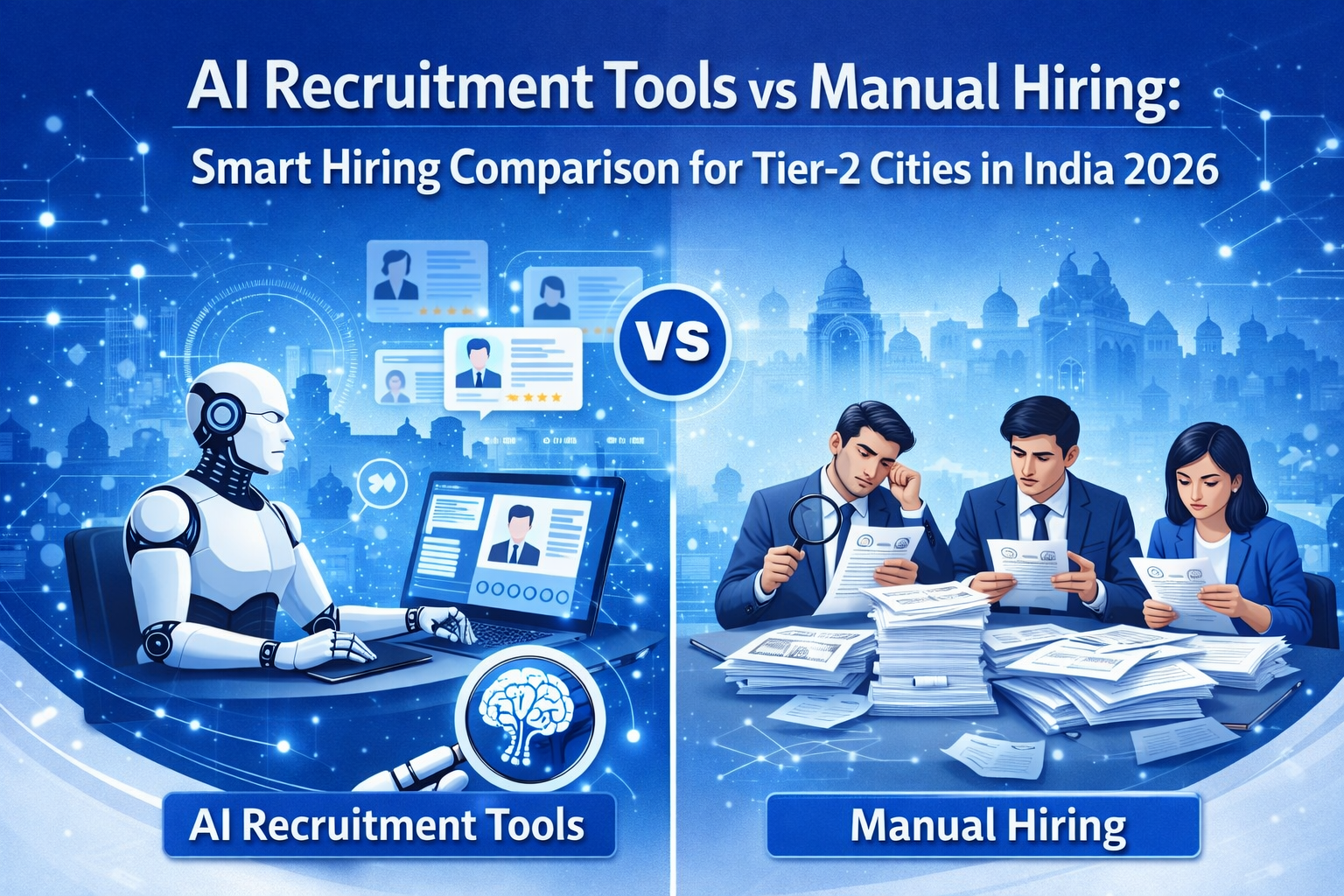
The talent acquisition landscape in Tier-2 Indian cities is undergoing a dramatic transformation. Cities like Pune, Hyderabad, Jaipur, Lucknow, and Kochi are emerging as vibrant talent hubs, attracting both local and multinational companies. Yet many organizations in these regions still rely on traditional manual hiring methods—phone calls, email chains, and paper-based resume screening. Meanwhile, forward-thinking companies are leveraging AI recruitment tools in India to hire faster, smarter, and at lower costs.
The question facing Tier-2 city organizations in 2026 is no longer whether to adopt AI recruitment solutions, but how quickly and strategically to implement them. This comprehensive comparison explores the stark differences between traditional manual hiring and modern AI recruitment tools in India, helping you make informed decisions about your talent acquisition strategy.
This guide breaks down the advantages and limitations of both approaches, provides real-world data on outcomes, and helps Tier-2 city organizations understand why smart hiring practices powered by AI are becoming essential for competitive advantage.
Understanding Manual Hiring vs AI Recruitment Tools in Tier-2 Cities
Before comparing, let's define what we mean by these two approaches:
Manual Hiring Process
Manual hiring relies on traditional recruitment methods: job postings on limited platforms, resume screening by hand, phone interviews scheduled through back-and-forth communication, and hiring decisions based primarily on recruiter intuition and interviewer impressions. In Tier-2 Indian cities, many organizations still depend almost exclusively on manual hiring approaches despite access to modern technology.
AI Recruitment Tools in India
Modern AI recruitment solutions automate and optimize the hiring process using machine learning, natural language processing, and predictive analytics. These smart hiring tools handle everything from intelligent resume parsing and candidate sourcing to automated communication and predictive success scoring. AI recruitment tools in India represent a fundamental shift in how organizations approach talent acquisition strategy and execution.
Head-to-Head Comparison: Manual Hiring vs AI Recruitment Tools
1. Recruitment Timeline and Speed
Manual Hiring:
- Average time-to-hire: 40-60 days for Tier-2 city organizations
- Multiple rounds of back-and-forth communication for scheduling
- Delayed decisions due to recruiter bottlenecks and manual processes
- Candidates often lose interest during prolonged processes
AI Recruitment Tools in India:
- Average time-to-hire: 15-25 days with smart hiring practices
- Instant scheduling with automated calendar management
- Real-time screening and prioritization of candidates
- Significantly reduced candidate drop-off rates
Outcome for Tier-2 cities: Using AI recruitment solutions reduces hiring time by 50-65%, enabling organizations to secure top talent before competitors in competitive Tier-2 markets.
2. Cost Efficiency and ROI
Manual Hiring Costs:
- Recruiter hours: 15-20 hours per successful hire
- Recruitment agency fees: typically 15-25% of first-year salary
- Administrative overhead and communication costs
- Cost-per-hire: ₹25,000-₹50,000+ for mid-level positions in Tier-2 cities
AI Recruitment Tools Costs:
- Software subscription: ₹20,000-₹50,000 per month for comprehensive solutions
- Recruiter hours: 3-5 hours per successful hire (70% reduction)
- No agency fees—significant savings on commission
- Cost-per-hire: ₹3,000-₹8,000 with AI recruitment tools in India
ROI Timeline: For Tier-2 city organizations hiring more than 5 employees monthly, AI recruitment tools pay for themselves within 2-3 months. Organizations implementing smart hiring practices see cumulative savings of ₹5-10 lakhs annually.
3. Candidate Quality and Fit Assessment
Manual Hiring Limitations:
- Subjective candidate evaluation prone to unconscious bias
- Limited ability to assess cultural fit objectively
- Inconsistent screening standards across different recruiters
- No predictive data on candidate success likelihood
- Bad hire rate: 40-50% in traditional organizations
AI Recruitment Tools Advantages:
- Objective skill-based evaluation reducing bias significantly
- Predictive analytics forecasting job success probability
- Consistent standardized screening across all candidates
- Cultural fit assessment through pattern recognition
- Bad hire rate: 10-15% with AI recruitment solutions
For Tier-2 city organizations where talent loss is particularly costly, AI recruitment tools in India reduce bad hires by 70-80%, translating to massive productivity and retention improvements.
4. Bias and Fairness in Hiring
Manual Hiring Challenges:
- Unconscious bias against unfamiliar educational backgrounds
- Geographic bias favoring candidates from major metros
- Gender and age bias in subjective evaluations
- Name-based discrimination despite legal protections
AI Recruitment Tools Benefits:
- Blind resume screening removing demographic identifiers
- Skills-focused evaluation rather than background preferences
- Equal treatment for candidates from all Tier-2 cities across India
- Transparent, documented evaluation criteria
- Regular bias auditing and fairness monitoring
Tier-2 city organizations using smart hiring practices powered by AI recruitment tools report 35-45% more diverse candidate pipelines and significantly higher employee satisfaction.
5. Candidate Experience and Employer Branding
Manual Hiring Experience:
- Slow communication creating frustration
- Unclear hiring timeline and status updates
- Candidates abandon applications due to delays
- Negative word-of-mouth affecting future recruitment
AI Recruitment Solutions Experience:
- Instant acknowledgment of application receipt
- Real-time status updates via chatbots or emails
- Quick interview scheduling reducing candidate uncertainty
- Professional, consistent communication building employer brand
- Enhanced employer reputation in Tier-2 city talent markets
Smart hiring practices using AI recruitment tools in India improve candidate satisfaction by 50-60%, creating positive employer brand effects that attract more qualified applicants in future hiring cycles.
Key Advantages of AI Recruitment Tools for Tier-2 Cities
1. Scalability Without Proportional Cost Increases
Whether Tier-2 city organizations are hiring 5 or 50 people, AI recruitment solutions scale seamlessly. Manual hiring requires proportionally more recruiter time and creates bottlenecks. Smart hiring tools maintain efficiency regardless of hiring volume.
2. Access to Passive Candidate Pools
AI recruitment tools in India actively search and identify passive candidates—professionals not actively job hunting but open to opportunities. This capability is especially valuable in Tier-2 cities where passive talent pools represent 70-80% of high-quality candidates. Traditional manual hiring only reaches active applicants.
3. Data-Driven Decision Making
Modern AI recruitment solutions provide dashboards showing hiring metrics, candidate pipeline health, time-to-hire trends, and quality indicators. Tier-2 city organizations gain strategic insights impossible with manual hiring, enabling continuous process optimization.
4. Bias Reduction and Diversity
AI recruitment tools follow standardized, transparent evaluation criteria, reducing unconscious bias inherent in manual screening. Organizations implementing these smart hiring tools report building more diverse, inclusive teams aligned with modern values and legal requirements.
5. 24/7 Candidate Engagement
AI-powered chatbots answer candidate questions, provide updates, and schedule interviews around the clock. For Tier-2 city talent pools where professionals work varied schedules, this 24/7 availability significantly improves engagement compared to business-hours-only manual communication.
6. Integration with Existing Systems
Top AI recruitment tools in India integrate seamlessly with existing HRIS, ATS, and communication platforms. This integration eliminates data silos, reduces administrative overhead, and creates unified candidate records accessible across your organization.
Limitations of Manual Hiring in Tier-2 City Context
Bottlenecks and Delays
Manual hiring creates multiple bottlenecks. Recruiters juggle multiple tasks, building schedules around their availability rather than candidate convenience. Tier-2 city organizations with limited HR staff find manual hiring particularly constraining, leading to extended hiring timelines that cost good candidates to competitors.
Inconsistent Decision Quality
Without standardized frameworks, different hiring managers apply different criteria to evaluate candidates. This inconsistency leads to some excellent candidates being rejected while mediocre candidates advance. Al recruitment tools in India eliminate this inconsistency through uniform evaluation criteria.
Limited Candidate Reach
Manual hiring through traditional job boards and referrals misses significant talent pools. Tier-2 city organizations relying on manual approaches fail to tap passive candidates and candidates from adjacent geographic areas, limiting the talent pool substantially compared to organizations using AI recruitment solutions.
Unconscious Bias Impact
Even well-intentioned recruiters harbor unconscious biases affecting candidate evaluation. Manual hiring perpetuates these biases systematically, whereas smart hiring practices with AI recruitment tools prevent bias at critical decision points.
Poor Scalability
Manual hiring doesn't scale efficiently. Doubling hiring needs doubles recruiter time and creates quality degradation. Modern AI recruitment tools in India maintain quality while scaling, critical for growing Tier-2 city organizations.
Smart Hiring Best Practices: Combining AI and Human Expertise
Hybrid Approach for Optimal Results
The best organizations don't choose between AI recruitment tools and human judgment—they combine both. AI recruitment solutions handle screening, scheduling, and data analysis. Recruiters focus on candidate engagement, relationship building, and final selection decisions. This hybrid approach using smart hiring practices leverages the strengths of both AI and human expertise.
Implementation Strategy for Tier-2 Cities
Phase 1: Assessment and Planning (Week 1-2)
- Audit current hiring process and identify pain points
- Calculate cost-per-hire and time-to-hire metrics
- Define success metrics for AI recruitment tools implementation
- Identify which recruiting roles benefit most from AI recruitment solutions
Phase 2: Tool Selection and Configuration (Week 3-4)
- Evaluate AI recruitment tools in India for Tier-2 city compatibility
- Configure screening criteria aligned with role requirements
- Set up integration with existing HRIS and communication systems
- Train recruiters on smart hiring tool usage
Phase 3: Pilot Program (Week 5-8)
- Launch AI recruitment solutions with one high-volume role
- Monitor metrics: time-to-hire, cost-per-hire, candidate quality
- Gather feedback from recruiters and hiring managers
- Refine configurations based on pilot results
Phase 4: Full Rollout and Optimization (Week 9+)
- Expand AI recruitment tools to all roles and departments
- Continuously monitor and optimize screening criteria
- Report on cost savings and quality improvements
- Plan for advanced features and future enhancements
Making the Transition: Practical Recommendations
For Small Tier-2 City Organizations (10-50 employees)
Start with focused AI recruitment solutions covering resume screening and candidate communication. These smart hiring tools deliver immediate time and cost savings. Manual scheduling can continue initially, transitioning to automated scheduling as you scale.
For Mid-Sized Organizations (50-250 employees)
Implement comprehensive AI recruitment tools in India covering sourcing, screening, communication, and scheduling. This scope delivers maximum ROI through recruitment cost reduction and quality improvement. Invest in training recruiters to maximize tool effectiveness.
For Large Organizations (250+ employees)
Deploy enterprise-grade AI recruitment solutions with full integration into HRIS, predictive analytics, and advanced diversity metrics. Supporting AI in recruitment with sophisticated talent intelligence enables strategic workforce planning and competitive advantage in Tier-2 city talent markets.
Measuring Success: Tier-2 City Benchmarks
| Metric | Manual Hiring | AI Recruitment Tools | Improvement |
|---|---|---|---|
| Time-to-Hire | 45-60 days | 15-25 days | 60-70% faster |
| Cost-Per-Hire | ₹30,000-₹50,000 | ₹3,000-₹8,000 | 80-90% reduction |
| Bad Hire Rate | 40-50% | 10-15% | 70-80% improvement |
| Candidate Experience | 3.2/5 satisfaction | 4.5/5 satisfaction | 40% improvement |
| Hiring Team Efficiency | 100% baseline | 70-75% time savings | 25-30% capacity increase |
| Diversity in Hires | 30-35% | 45-55% | 40-50% improvement |
Related Resources for Tier-2 City Hiring Strategy
For comprehensive understanding of modern recruitment approaches, explore talent acquisition strategies and how they've evolved with AI. Additionally, understanding broader talent management principles helps contextualize AI recruitment tools within your overall HR strategy.
Common Concerns and Misconceptions
"AI Tools Will Replace Our Recruiters"
Incorrect. AI recruitment tools automate repetitive screening and scheduling tasks, freeing recruiters to focus on high-value activities: candidate engagement, cultural assessment, and strategic hiring decisions. Recruiters become more valuable, not obsolete, with smart hiring practices.
"AI Tools Are Only for Large Enterprises"
False. Modern AI recruitment solutions in India scale from startups to enterprises. Many cloud-based tools offer flexible pricing supporting organizations of all sizes. Even small Tier-2 city companies benefit from automation and cost reduction through smart hiring tools.
"AI Tools Introduce Algorithmic Bias"
While AI can perpetuate historical biases if poorly designed, modern AI recruitment tools explicitly address bias reduction. Transparent, auditable algorithms combined with human oversight provide fairer hiring than traditional manual approaches prone to unconscious bias.
"Implementation is Too Complex"
Most modern AI recruitment solutions feature intuitive interfaces and comprehensive training. Implementation timelines of 2-8 weeks are typical, with ongoing vendor support ensuring smooth adoption of smart hiring practices.
"Candidates Dislike AI Screening"
Research shows candidates actually prefer AI recruitment tools providing faster feedback, clear communication, and transparent processes compared to slow, opaque traditional hiring. Candidate satisfaction improves with smart hiring tools, not diminishes.
The Future of Hiring in Tier-2 Cities
The competitive landscape for talent in Tier-2 Indian cities is accelerating. Organizations that embrace AI recruitment tools and smart hiring practices now gain substantial advantages:
- Faster hiring enabling securing top talent before competitors
- Lower costs improving profitability and allowing investment in growth
- Better quality hires improving team productivity and retention
- More diverse teams building inclusive, innovative organizations
- Superior candidate experiences building positive employer brands
By 2027-2028, we expect 70% of Tier-2 city organizations will have adopted some form of AI recruitment solutions. Early adopters implementing smart hiring practices now will establish competitive advantages that persist for years.
Conclusion: Making Your Choice
The comparison between manual hiring and AI recruitment tools in India is clear: modern smart hiring practices powered by AI deliver superior results across virtually every dimension. For Tier-2 city organizations competing for talent in an increasingly challenging market, AI recruitment solutions represent not a luxury but a strategic necessity.
The question isn't whether to adopt AI recruitment tools in India, but when and how comprehensively to do so. Organizations that move decisively to implement smart hiring practices will enjoy lasting competitive advantages in recruitment speed, cost, quality, and employer brand—advantages that compound over time as they build stronger teams faster.
Your journey to smarter hiring starts with a single step: evaluating your current manual processes, calculating their true costs, and exploring how AI recruitment solutions can transform your talent acquisition strategy. The investments required are modest; the returns are substantial; the competitive imperative is clear.
Frequently Asked Questions
1. How long does implementation of AI recruitment tools take?
Typical implementation of AI recruitment solutions for Tier-2 city organizations takes 2-8 weeks depending on complexity, integration needs, and organizational readiness. Starting with a pilot program can accelerate experience and adoption of smart hiring practices.
2. What's the total cost of ownership for AI recruitment tools?
Cloud-based AI recruitment tools in India cost ₹20,000-₹50,000 monthly depending on features and hiring volume. However, cost-per-hire savings typically cover this investment 2-3 times over for organizations hiring 5+ employees monthly using smart hiring tools.
3. Can AI recruitment solutions integrate with our existing systems?
Yes, modern AI recruitment tools in India integrate with standard HRIS platforms, ATS systems, and communication tools. Integration usually happens within the first 2-4 weeks of implementation of smart hiring practices.
4. What happens to our recruiting team when we implement AI?
Your recruiting team's role evolves from operational (screening, scheduling) to strategic (relationship building, final decisions). With appropriate training, smart hiring tools increase recruiter productivity and job satisfaction through elimination of repetitive tasks.
5. How do we ensure fair hiring with AI recruitment tools?
Quality AI recruitment solutions in India incorporate fairness principles, include bias auditing features, and provide transparency into decision-making. Combine technology with human oversight of final decisions to ensure equitable hiring with smart hiring practices.
6. Can small organizations in Tier-2 cities benefit from AI recruitment tools?
Absolutely. Even organizations hiring occasionally benefit from faster, cheaper hiring using AI recruitment solutions. Flexible pricing models and cloud-based access make smart hiring tools accessible to organizations of all sizes across India.