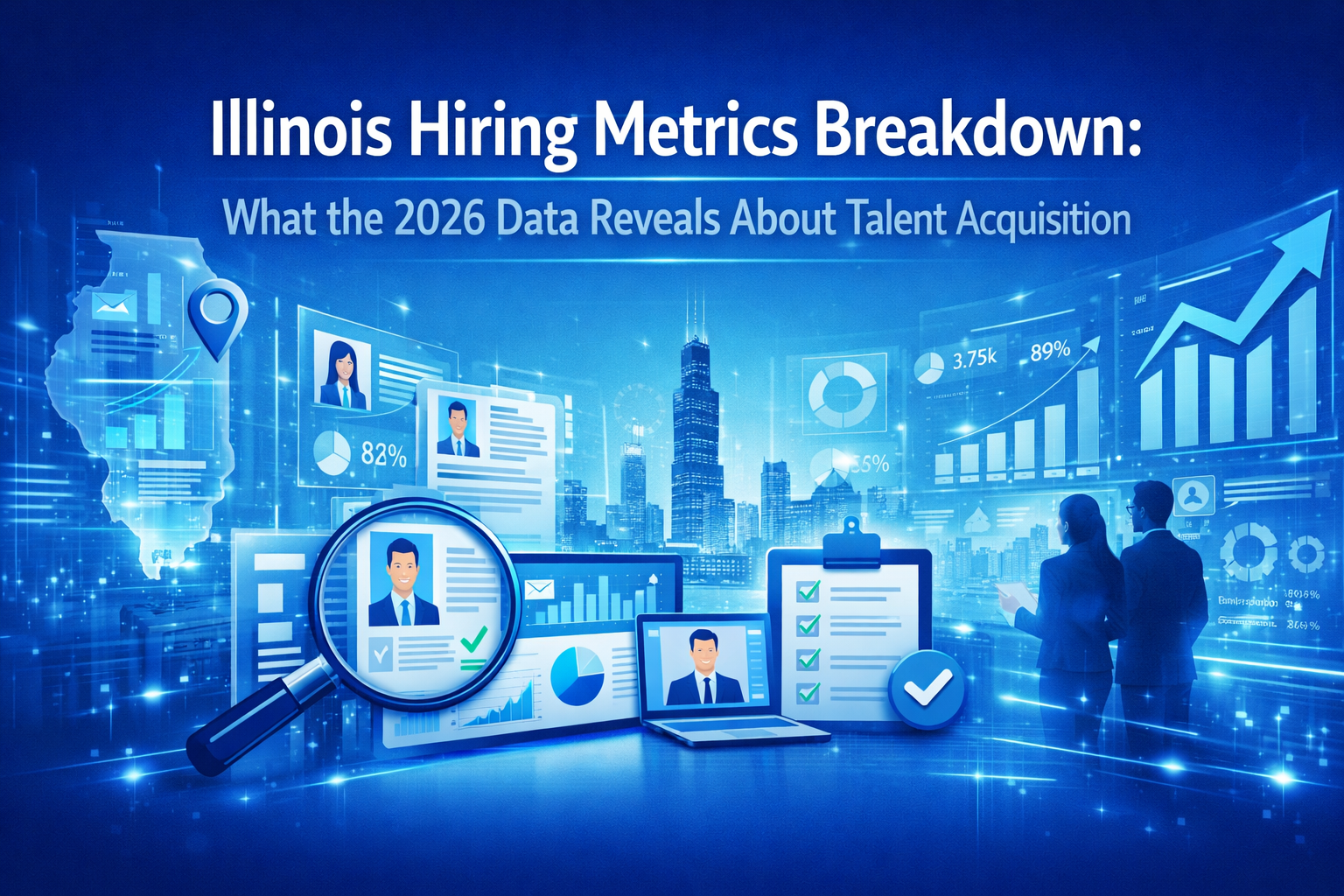
In 2026, recruitment is no longer just about filling open roles—it's about making data-driven hiring decisions that improve efficiency, reduce costs, and enhance candidate experience. Across Illinois, companies are increasingly relying on recruitment metrics and analytics to stay competitive in a fast-changing talent market.
From bustling hiring hubs like Chicago to growing job markets in Springfield and Naperville, understanding hiring benchmarks is essential for success.
In this blog, we break down the top Illinois hiring metrics for 2026, what they reveal about talent acquisition trends, and how businesses can optimize their recruitment strategies.
Why Hiring Metrics Matter in Illinois in 2026
The job market in Illinois has become increasingly competitive, especially in sectors like IT, healthcare, finance, and manufacturing. Companies are facing:
- Talent shortages in specialized roles
- Increased competition for skilled candidates
- Rising hiring costs
- Demand for faster recruitment processes
This is where hiring metrics in Illinois play a crucial role. By tracking key recruitment KPIs, organizations can:
- ✔ Improve hiring efficiency
- ✔ Reduce cost-per-hire
- ✔ Enhance candidate experience
- ✔ Strengthen employer branding
Key Illinois Hiring Metrics Breakdown (2026)
Let's explore the most important recruitment metrics in Illinois and what they reveal.
1. Time-to-Hire in Illinois
Definition: The number of days between a candidate applying and accepting an offer.
2026 Insight:
In cities like Chicago, the average time-to-hire ranges from 18 to 25 days, depending on the industry.
What It Reveals:
- Companies are prioritizing faster hiring cycles
- Delays often result in losing top candidates
- Automation and AI are reducing hiring timelines
How to Improve:
- Use AI recruitment strategies in Illinois
- Automate resume screening
- Streamline interview processes
2. Cost-per-Hire in Illinois
Definition: Total recruitment cost divided by the number of hires.
2026 Insight:
The cost-per-hire in Illinois ranges between $3,500–$5,000, with higher costs in urban hubs like Chicago.
What It Reveals:
- Employer branding plays a major role in reducing costs
- Companies relying on paid channels spend more
- Internal referrals reduce hiring expenses
Optimization Tips:
- Invest in employer branding in Illinois
- Leverage employee referral programs
- Use data-driven recruitment strategies
3. Quality-of-Hire
Definition: Measures the value a new hire brings to the company.
2026 Insight:
Organizations in Illinois are increasingly using performance data and retention rates to evaluate quality-of-hire.
What It Reveals:
- Data-driven hiring leads to better employee performance
- AI improves candidate matching accuracy
- Strong onboarding increases employee success
Best Practices:
- Use predictive analytics
- Track employee performance metrics
- Align hiring with business goals
4. Offer Acceptance Rate
Definition: Percentage of candidates who accept job offers.
2026 Insight:
In Naperville and Springfield, the offer acceptance rate ranges from 75% to 85%.
What It Reveals:
- Employer brand significantly influences decisions
- Compensation and flexibility matter more than ever
- Candidate experience plays a key role
How to Improve:
- Offer competitive salaries
- Improve communication during hiring
- Enhance candidate experience
5. Candidate Experience Score
Definition: Measures how candidates perceive the hiring process.
2026 Insight:
Companies in Chicago are focusing heavily on candidate-centric hiring to improve satisfaction scores.
What It Reveals:
- Poor experience damages employer brand
- Transparent communication improves engagement
- Fast responses increase satisfaction
Tips:
- Use AI chatbots for 24/7 candidate support
- Provide regular updates
- Simplify application processes
6. Source of Hire
Definition: Identifies where successful candidates come from.
2026 Insight:
Top sources in Illinois include:
- Job portals
- Employee referrals
- LinkedIn recruiting
- Career websites
What It Reveals:
- Referrals provide higher-quality candidates
- Social recruiting is growing rapidly
- Data helps identify the most effective channels
7. Diversity Hiring Metrics
Definition: Tracks diversity in recruitment.
2026 Insight:
Companies across Illinois are prioritizing diversity, equity, and inclusion (DEI) initiatives.
What It Reveals:
- Diverse teams improve innovation
- Inclusive hiring boosts employer branding
- AI tools help reduce hiring bias
Illinois Talent Acquisition Trends in 2026
🔹 1. Rise of AI in Recruitment
Businesses in Chicago are adopting AI recruitment tools for automation, screening, and analytics.
🔹 2. Data-Driven Hiring
Companies are shifting toward recruitment analytics in Illinois to improve decision-making.
🔹 3. Remote & Hybrid Hiring
Remote work trends are expanding talent pools beyond Illinois.
🔹 4. Employer Branding Focus
Strong employer branding is helping organizations attract top talent and reduce hiring costs.
How to Improve Hiring Metrics in Illinois
To stay competitive in the Illinois job market, companies should:
- ✔ Use AI-Powered Recruitment Tools - Automate repetitive tasks and improve efficiency
- ✔ Focus on Employer Branding - Build a strong online presence and reputation
- ✔ Track Recruitment KPIs - Monitor performance and optimize strategies
- ✔ Enhance Candidate Experience - Ensure a smooth and engaging hiring process
- ✔ Leverage Data Analytics - Make smarter hiring decisions with real-time insights
Benefits of Tracking Hiring Metrics
Organizations in Chicago and beyond are seeing measurable benefits:
- Faster hiring cycles
- Reduced recruitment costs
- Improved employee retention
- Better hiring decisions
- Stronger employer brand
Conclusion
The 2026 hiring landscape in Illinois is driven by data, technology, and candidate expectations. By understanding and optimizing key Illinois hiring metrics, businesses can significantly improve their talent acquisition outcomes.
From time-to-hire and cost-per-hire to candidate experience and diversity hiring, every metric provides valuable insights into recruitment performance.
Companies that embrace data-driven talent acquisition in Illinois will not only hire better—but also build a stronger employer brand and long-term workforce success.