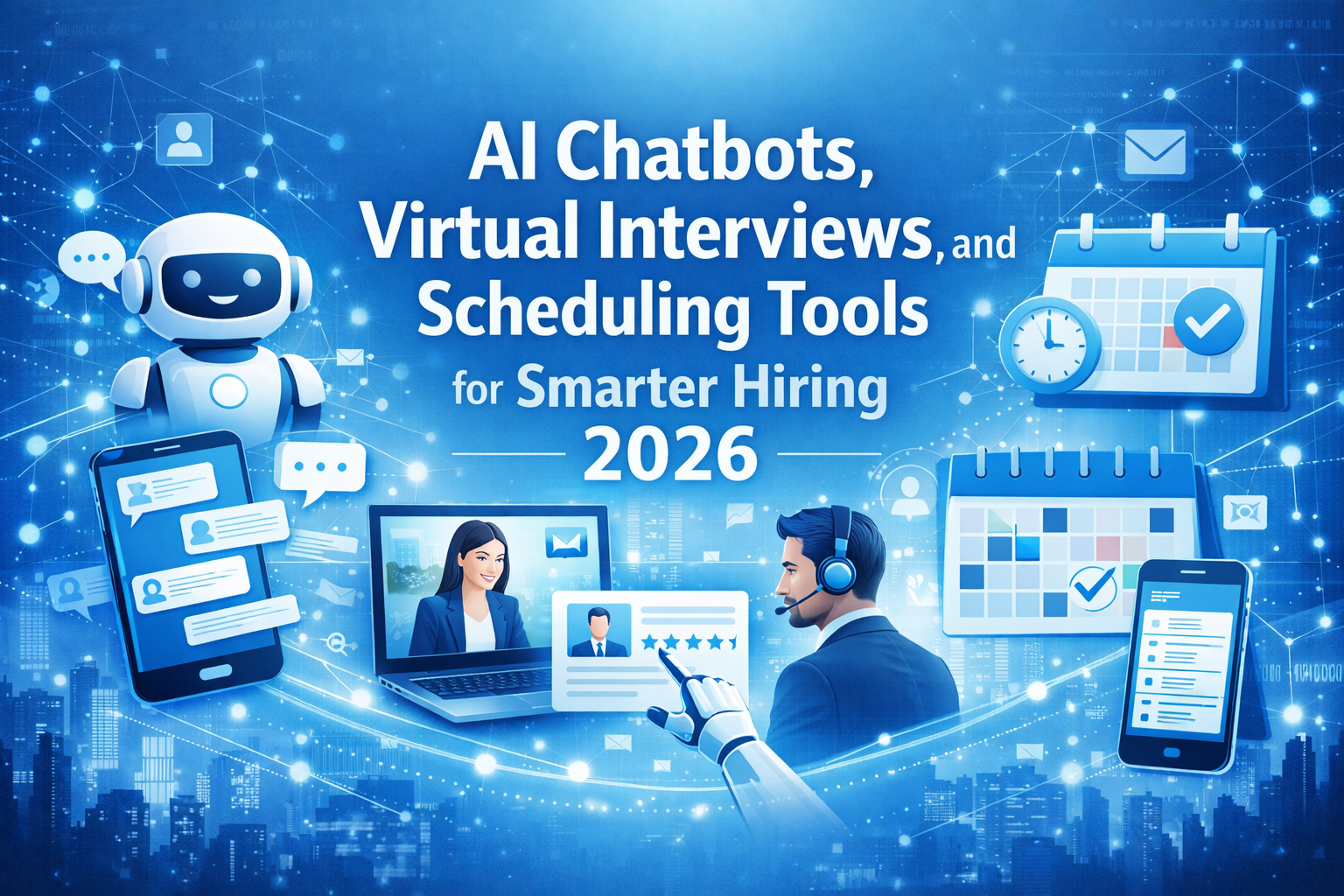
The modern hiring landscape is undergoing a dramatic transformation. Today's most competitive organizations are leveraging AI-powered chatbots, virtual interview platforms, and intelligent scheduling systems to streamline recruitment workflows, enhance candidate experiences, and make hiring decisions faster than ever before.
No longer are candidates waiting days for interview confirmations or struggling to find available time slots with busy recruiters. With AI chatbots handling initial engagement, virtual interview tools conducting preliminary assessments, and automated scheduling eliminating coordination headaches, recruitment has become more efficient, scalable, and candidate-friendly.
This article explores how these three interconnected technologies are revolutionizing hiring in 2026 and why smart organizations are adopting them now.
The Rise of AI Chatbots in Recruitment
Recruitment chatbots are conversational AI systems designed to interact with job applicants and candidates throughout the hiring funnel. Unlike traditional email-based communication, chatbots provide instant, 24/7 responses that keep candidates engaged and informed at every stage.
What Recruitment Chatbots Do
Modern recruitment chatbots handle a wide range of tasks:
- Instant Candidate Engagement: Answer frequently asked questions about job descriptions, company culture, benefits, and application requirements without recruiter involvement
- Application Qualification: Ask screening questions to verify baseline qualifications before candidates enter the formal review process
- Interview Scheduling: Propose available interview slots and manage confirmations instantly
- Status Updates: Keep candidates informed about where they stand in the hiring process, reducing anxiety and improving candidate experience
- Data Collection: Gather additional information (skills, portfolio links, references) conversationally rather than through rigid forms
- Candidate Nurturing: Maintain relationships with passive candidates and talent pool members for future opportunities
Benefits of Recruitment Chatbots
For Recruiters: Chatbots handle repetitive administrative communication, freeing recruiters to focus on relationship-building and strategic decision-making. A single chatbot can manage hundreds of candidate conversations simultaneously, dramatically improving team productivity.
For Candidates: Instant responses and clear communication reduce frustration and improve the overall hiring experience. Candidates feel valued when they receive immediate feedback rather than being left in the dark.
For Organizations: Better candidate experience leads to stronger employer branding, higher acceptance rates for offers, and improved talent pool quality for future roles.
Virtual Interview Tools: The Future of Candidate Assessment
Virtual interview platforms have evolved far beyond simple video calls. Modern solutions combine video interviewing, AI-powered analysis, and structured assessment frameworks to evaluate candidates more objectively and consistently.
Types of Virtual Interview Tools
1. One-Way Video Interviews — Candidates record answers to pre-set questions at their convenience. Recruiters review videos asynchronously, allowing flexible scheduling and reducing meeting coordination complexity.
2. Live Virtual Interviews — Real-time video conversations using dedicated hiring software with features like screen sharing, whiteboarding, and interview recording for team review.
3. AI-Enhanced Virtual Interviews — Advanced platforms that analyze candidate responses, detect key competencies, assess communication skills, and provide objective scoring recommendations. Some systems even use natural language processing to extract sentiment, confidence levels, and relevant experience mentions.
4. Structured Assessment Interviews — Standardized question sets administered virtually to ensure all candidates are evaluated on identical criteria, reducing unconscious bias and improving hiring consistency.
Key Advantages of Virtual Interview Platforms
Scalability: Virtual interviews allow organizations to evaluate hundreds of candidates without geographic or scheduling constraints. A global company can interview talent pools across multiple time zones simultaneously.
Objective Assessment: Recorded interviews and AI-powered analysis reduce subjective judgment and help teams focus on relevant competencies.
Cost Efficiency: Virtual interviews eliminate travel costs and time investments associated with in-person interviews, making hiring more accessible for remote and distributed teams.
Better Candidate Experience: Flexibility in scheduling one-way interviews and the ability to interview at one's comfort level reduces interview anxiety and improves candidate performance.
Data-Driven Decisions: Video analysis and assessment scoring provide objective data that supports consistent, defensible hiring decisions.
By integrating virtual interview tools with intelligent AI recruitment solutions, organizations can create comprehensive assessment pipelines that evaluate candidates more systematically than traditional unstructured interviews.
Automated Scheduling: Eliminating the Coordination Nightmare
One of the biggest time-consumers in recruitment is scheduling interviews. Back-and-forth emails, timezone confusion, and calendar coordination have historically been major friction points in the hiring process.
How Automated Scheduling Works
Modern scheduling tools integrate with calendar systems (Google Calendar, Outlook) and run on the following logic:
- Recruiter Availability Input: Recruiters input their available time slots for interviews
- Candidate Preference Collection: Chatbots or scheduling invitations ask candidates for their preferred interview times
- Automatic Matching: The system finds common availability windows that suit both parties
- Confirmation: Meeting details, video call links, and reminders are automatically sent to both candidate and interviewer
- Follow-Up: The system sends reminders hours before the scheduled interview to reduce no-shows
Real Benefits of Automated Scheduling
Time Savings: What previously took hours of back-and-forth communication now happens in minutes. A recruiter screening 20 candidates saves roughly 10+ hours of scheduling time per month.
Reduced No-Shows: Automated reminders and calendar integrations significantly improve interview attendance rates, reducing wasted recruiter time and poor candidate experiences.
Timezone Management: Automated systems easily handle global hiring by converting times to the candidate's local timezone and preventing scheduling errors.
Improved Candidate Experience: Candidates can schedule interviews on their own terms rather than being forced into recruiter-dictated time slots, making your company more candidate-friendly and competitive in talent wars.
Data Collection: Scheduling systems automatically log interview times, allowing you to measure time-to-hire and identify bottlenecks in your hiring funnel.
How These Technologies Work Together
The real power emerges when AI chatbots, virtual interview tools, and automated scheduling work in harmony:
Candidate Journey: A potential hire lands on your careers page. A chatbot immediately greets them, answers questions about the role, and asks initial screening questions. Once qualified, the chatbot proposes interview times. The candidate selects a preferred slot. An automated scheduler confirms the meeting and sends a video interview link. The candidate completes a one-way video interview on their own schedule. The recruiting team reviews the recording, leverages candidate assessment tools to evaluate responses, and moves qualified candidates forward.
This entire workflow — which once took 2-3 weeks of manual coordination and email exchanges — now happens in days with minimal recruiter involvement.
Why Organizations Are Adopting These Tools Now
1. Competitive Pressure
Organizations that slow down their hiring processes risk losing top talent to faster-moving competitors. AI-powered solutions are becoming table stakes in competitive markets.
2. Candidate Expectations
Modern job seekers expect instant communication and flexible scheduling. Companies that force candidates through rigid, slow hiring processes face higher dropout rates and damaged employer brands.
3. Cost Efficiency
As organizations face pressure to do more with smaller recruitment teams, these automation tools provide immediate ROI through time and resource savings.
4. Data and Objectivity
Digital records of candidate interactions and AI-powered assessment insights help organizations make more defensible, objective hiring decisions in a legal and compliance-conscious environment.
Potential Challenges and How to Address Them
Candidate Privacy and Data Security
Organizations must ensure that chatbot conversations and video interviews are stored securely and comply with data protection regulations (GDPR, CCPA, etc.).
Maintaining Human Touch
While automation improves efficiency, organizations must ensure that personal recruiting relationships don't disappear entirely. Strategic touchpoints where recruiters engage directly with candidates remain valuable.
Ensuring AI Fairness
If AI analysis of interview responses or chatbot screening is biased, it can perpetuate unfair hiring practices. Organizations must audit and monitor these systems for bias regularly.
Technical Integration
Implementing multiple platforms requires careful integration planning to ensure data flows smoothly between chatbot, interview, scheduling, and ATS systems.
The Future: AI-Powered End-to-End Hiring
Looking ahead to 2026 and beyond, we can expect:
- Predictive Graduation: AI systems will predict which candidates are likely to succeed in specific roles based on interview performance patterns
- Deeper Candidate Insights: Advanced video analysis will extract soft skills like leadership potential, collaboration ability, and cultural fit
- Multi-Language Support: Chatbots and interview analysis will support global hiring with automated translation and cultural adaptation
- Integrated Candidate Experience: Seamless, omnichannel experiences where candidates can move between chatbot, video interview, and live recruiter interactions without friction
- Real-Time Collaboration: Recruiting teams will collaborate in real-time around AI-generated insights, making faster, more informed decisions
Key Takeaways for 2026 Hiring Leaders
1. These tools are no longer optional — Leading organizations are already using AI chatbots, virtual interviews, and automated scheduling to outpace competitors in talent acquisition speed.
2. Focus on the candidate experience — The best organizations use these technologies to create faster, more respectful hiring journeys that candidates actually enjoy.
3. Maintain human judgment — Automation should free recruiters for high-value work, not eliminate human insight from hiring decisions.
4. Plan for integration — Select platforms that work together seamlessly and integrate with your existing ATS and HRIS systems.
5. Monitor for bias — Regularly audit AI-powered systems to ensure they're making fair, objective decisions.
Conclusion
AI chatbots, virtual interviews, and automated scheduling represent a fundamental shift in how modern organizations hire. By combining these technologies thoughtfully, recruitment leaders can dramatically improve speed, consistency, candidate experience, and hiring quality.
The organizations that embrace these tools in 2026 won't just fill positions faster — they'll create hiring experiences that candidates want to talk about and that attract stronger future applicants. In a competitive talent market, that's a game-changing advantage.
FAQs About AI Chatbots, Virtual Interviews, and Scheduling
1. Can AI chatbots really handle candidate screening?
Yes, modern recruitment chatbots are designed to ask predefined screening questions, evaluate responses, and provide recruiters with qualified candidates who meet baseline requirements.
2. How objective are AI-powered interview assessments?
AI-powered assessments are more consistent than human judgment alone, but they should be part of a larger evaluation process that includes human review and decision-making.
3. What happens if a candidate misses their scheduled interview?
Automated scheduling systems send reminders and allow candidates to reschedule through the platform, significantly reducing no-show rates compared to traditional calling or emailing.
4. Are virtual interviews as effective as in-person interviews?
Research shows that virtual interviews can be equally effective, especially when combined with structured questions and objective assessment criteria. They also provide flexibility and reduce scheduling friction.
5. How do I ensure these tools don't create bias in hiring?
Regularly audit your systems, use structured questions that are identical for all candidates, monitor AI recommendations for patterns of discrimination, and ensure human reviewers validate all AI recommendations.
6. Can these tools work for different industries?
Yes, chatbots, virtual interviews, and scheduling tools can be customized for any industry, from tech to healthcare to retail, by adjusting questions and assessment criteria specific to your sector.
7. What's the typical implementation timeline?
Most organizations can implement basic chatbot and scheduling functionality within 4-8 weeks, though full integration with existing systems may take 3-4 months.