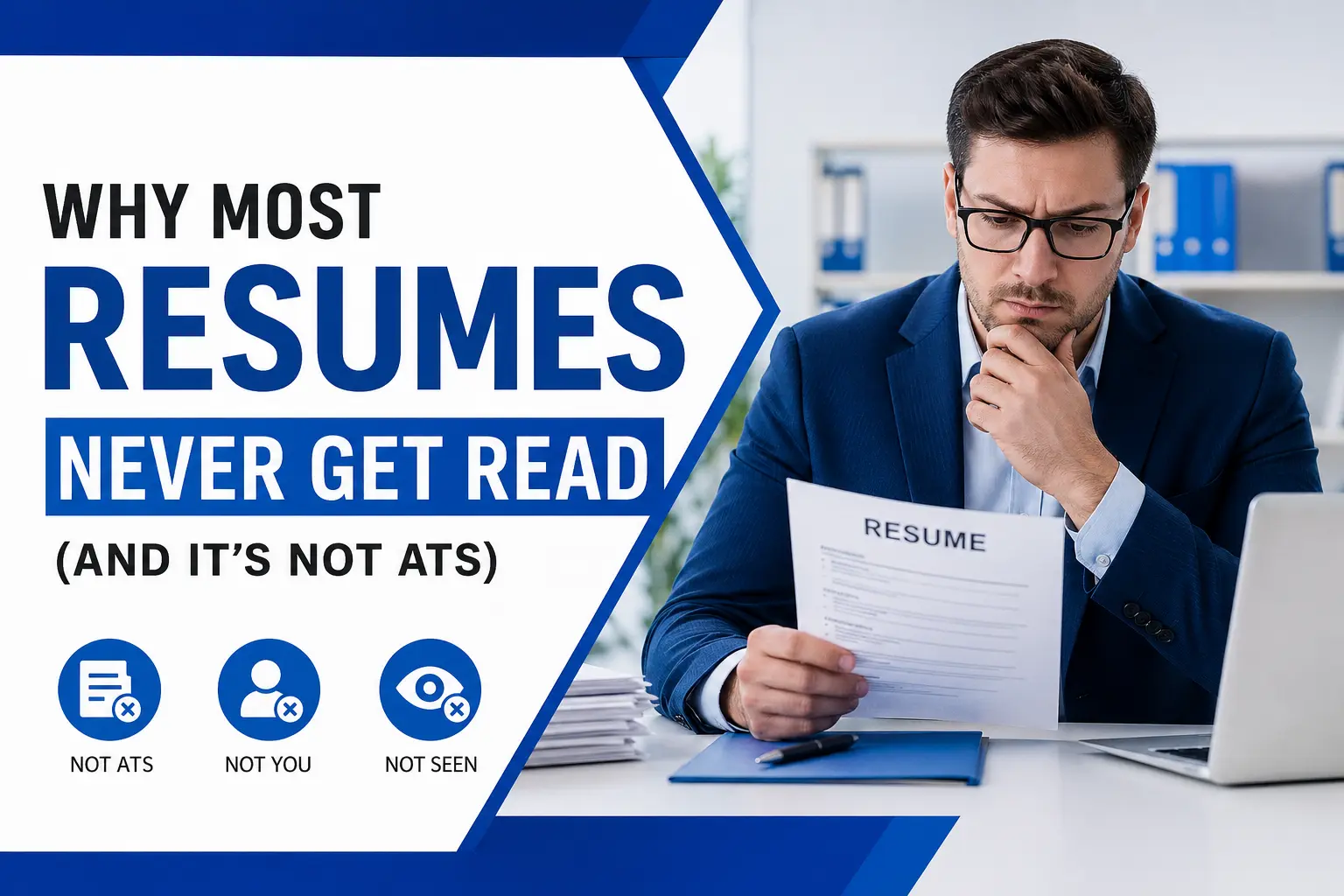
The Brutal Truth Candidates Don't Want to Hear
Your resume is not getting ignored because of ATS.
Yes, you read that right.
For years, candidates have blamed Applicant Tracking Systems (ATS) for rejections. But the real reason most resumes never get read is much simpler—and harder to accept.
Your resume fails to grab human attention.
Recruiters are not rejecting you because a system filtered you out. They are rejecting you because your resume doesn't stand out in seconds.
Let's break this myth and uncover the real reasons behind resume rejection.
The Biggest Myth: ATS Is the Problem
Why Everyone Blames ATS
The internet is full of advice like:
- "Optimize for ATS"
- "Use the right keywords"
- "Avoid fancy formatting"
While ATS does play a role in modern hiring, it's not the main reason your resume is ignored.
Most resumes that reach recruiters are still rejected by humans.
The Real Reason: Recruiters Don't Have Time
The 6–10 Second Rule
Recruiters spend just a few seconds on each resume.
In that short time, they decide:
- Is this candidate relevant?
- Should I continue reading?
- Does this match the job role?
If your resume doesn't answer these questions instantly, it gets skipped.
Why Most Resumes Never Get Read
1. Lack of Clear Positioning
Many resumes try to say everything.
Result? They say nothing clearly.
Recruiters should immediately understand:
- Your role
- Your expertise
- Your relevance
If they have to "figure it out," they move on.
2. Weak Resume Headlines
Your resume headline is your first impression.
Bad example:
"Hardworking and motivated individual"
Good example:
"Sales Executive with 3+ Years in B2B Lead Generation"
Specific beats generic every time.
3. No Keyword Alignment
Even though ATS is not the main problem, keywords still matter.
Recruiters search resumes using:
- Job titles
- Skills
- Tools
If your resume doesn't match the job description keywords, it may never show up in searches.
4. Poor Formatting and Structure
A cluttered resume kills readability.
Common mistakes:
- Long paragraphs
- No bullet points
- Poor spacing
- Overdesign
A recruiter should scan your resume easily—not struggle to read it.
5. Listing Duties Instead of Achievements
Most candidates write:
- "Responsible for sales"
- "Handled customer queries"
But recruiters want:
- Results
- Impact
- Numbers
Example: "Increased sales by 30% in 6 months" — that gets attention.
6. Applying Without Customization
Sending the same resume to every job is one of the biggest mistakes.
Each job has different requirements.
A generic resume = low relevance = instant rejection.
The Truth About Recruiter Behavior
Recruiters Are Not Reading—They're Scanning
This is important.
Recruiters:
- Scan quickly
- Look for patterns
- Focus on relevance
They are not analyzing deeply unless your resume passes the first scan.
Your goal is to earn attention, not explain everything.
The Role of AI Hiring Tools (But Not the Villain)
Modern hiring uses:
- AI recruitment tools
- ATS systems
- Resume screening software
These tools help recruiters:
- Filter candidates faster
- Search profiles using keywords
- Manage bulk applications
But even after passing AI filters, your resume still needs to impress a human. Understanding how AI recruitment software compares with traditional ATS can give you a real advantage in knowing what hiring systems actually look for.
Why Good Candidates Still Get Ignored
This is the harsh reality: being qualified is not enough.
You can have:
- Great skills
- Strong experience
- Good education
And still get ignored. Why?
- Your resume doesn't show it clearly
- Your positioning is weak
- Your value is not visible quickly
Resume vs Reality: What Candidates Think vs What Happens
Candidate Thinking: "I have the right skills, I should get selected."
Recruiter Reality: "Does this resume match what I need right now?"
Hiring is about fit, not fairness. This is one of the biggest lies candidates believe about hiring—that merit alone is enough to get noticed.
High-Impact Resume Strategy That Works
1. Start With a Strong Summary
Your top section should clearly say:
- Who you are
- What you do
- Your key strength
2. Use Role-Specific Keywords
Match your resume with:
- Job description
- Industry keywords
- Skill requirements
3. Show Results, Not Responsibilities
Always focus on:
- Achievements
- Measurable impact
- Business outcomes
4. Keep It Clean and Readable
Use:
- Bullet points
- Short sentences
- Clear headings
5. Customize Every Application
Even small changes can improve your chances:
- Adjust keywords
- Highlight relevant experience
- Align with job role
The Hidden Impact of Bulk Hiring
In industries with bulk hiring:
- Recruiters handle thousands of resumes
- Decisions are faster
- Rejection rate is higher
In such cases, only the most relevant resumes survive.
Why Speed Matters in Hiring
Recruiters often shortlist candidates within the first 24–48 hours.
If you apply late or your resume isn't strong, you may never be seen.
How Technology Is Changing Resume Screening
With AI hiring tools and recruitment automation, hiring is becoming:
- Faster
- Data-driven
- Keyword-focused
But one thing hasn't changed: humans still make the final decision.
The Final Truth Candidates Must Accept
Most resumes never get read—not because of ATS, but because they fail to capture attention.
The hiring process is:
- Competitive
- Fast-paced
- Attention-driven
The Solution: How to Get Your Resume Read
If you want results:
- ✔ Be clear, not clever
- ✔ Be relevant, not generic
- ✔ Be impactful, not descriptive
- ✔ Be visible, not hidden
Soft Brand Positioning: The Recruitment Tool Angle
Today's hiring world is powered by AI recruitment tools and smart hiring systems.
Companies are moving towards:
- Faster screening
- Better candidate matching
- Data-driven hiring decisions
Understanding how these systems work gives both recruiters and candidates a powerful advantage.
Conclusion
The idea that "ATS is rejecting your resume" is comforting—but misleading.
The real reason most resumes fail is simple: they don't stand out to recruiters.
Fix that, and everything changes.