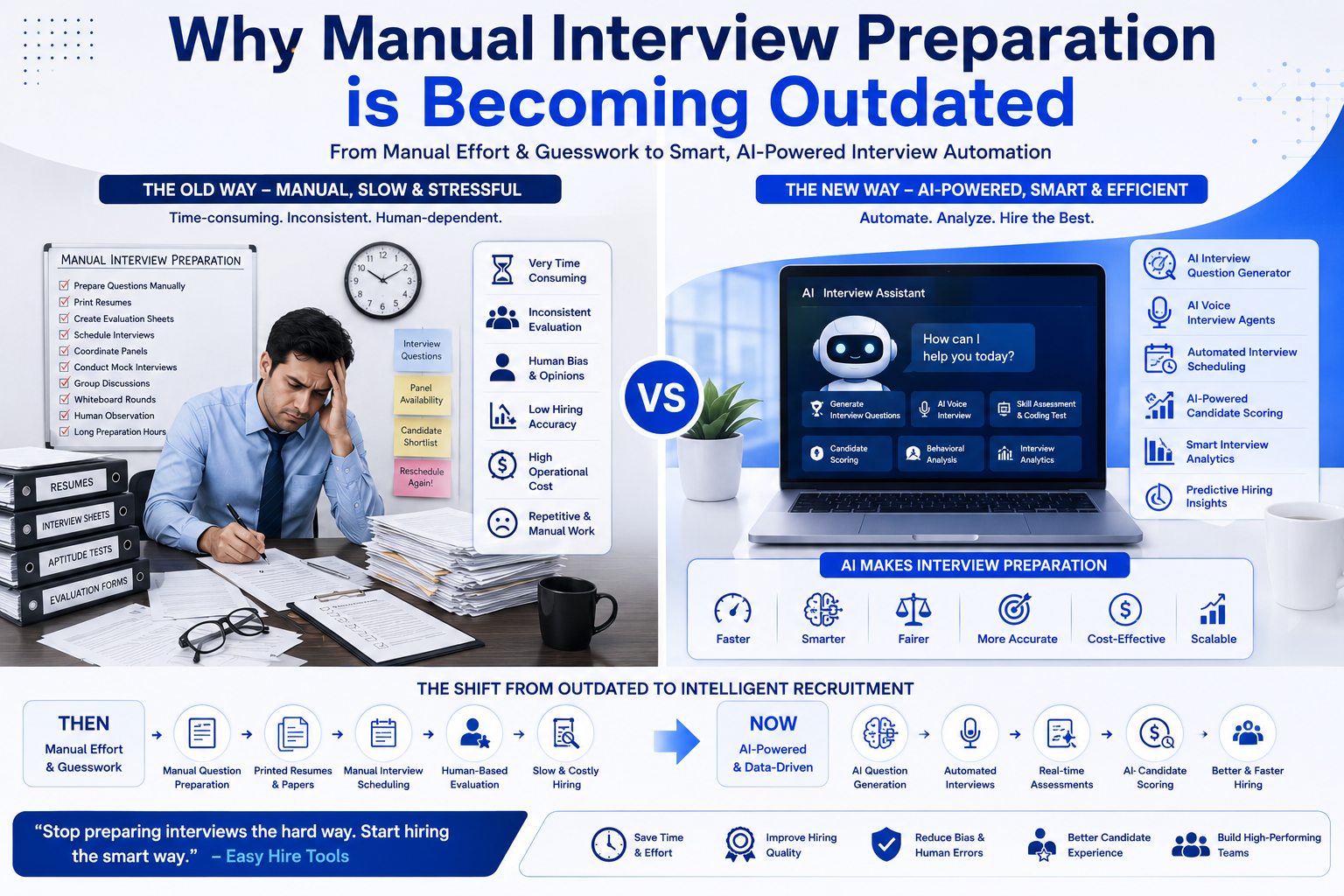
There was a time when interview preparation felt like preparing for a major battlefield.
Inside crowded HR cabins, recruiters sat late into the evening surrounded by printed resumes, interview sheets, notepads, and endless coffee cups. Hiring managers discussed technical questions repeatedly while HR teams coordinated interview panels over phone calls and emails.
Before every hiring drive, there was pressure.
Pressure to create the right interview questions.
Pressure to shortlist the right candidates.
Pressure to organize smooth interview rounds.
And most importantly, pressure to avoid hiring mistakes.
In the ancient recruitment era, interview preparation was completely manual.
HR professionals spent hours:
- Preparing interview questionnaires
- Printing candidate resumes
- Creating aptitude sheets
- Scheduling interview panels
- Organizing mock interview rounds
- Designing technical assessments manually
Everything depended on human effort.
A recruiter's experience, instincts, and judgment played the biggest role in candidate evaluation. Companies believed they could identify the best talent through communication skills, confidence, body language, and first impressions.
But recruitment has changed dramatically.
In 2026, businesses are moving away from traditional interview preparation methods and adopting AI-powered hiring systems. Companies now use AI interview question generators, AI voice interview agents, recruitment automation platforms, and predictive hiring analytics to streamline recruitment faster than ever before.
The shift from manual interview preparation to intelligent AI recruitment technology is transforming the future of hiring.
This is exactly why manual interview preparation is becoming outdated.
Ancient Recruitment and Traditional Interview Preparation
The Old Hiring World
Before AI recruitment tools existed, hiring was a completely human-driven process.
Every recruitment campaign required extensive planning.
Recruiters manually coordinated:
- Candidate shortlisting
- Interview schedules
- Technical rounds
- Assessment papers
- Group discussions
- HR interview sessions
The process consumed massive amounts of time and energy.
HR Preparing Interview Questions Manually
One of the biggest responsibilities for recruiters was preparing interview questions manually.
HR teams worked closely with hiring managers to create:
- Behavioral questions
- Communication assessments
- Role-specific questionnaires
- Technical interview templates
For every new role, recruiters repeated the same process again and again.
This became exhausting, especially during bulk hiring campaigns.
Managers Creating Technical Questionnaires
Technical hiring was even more challenging.
Department heads manually created:
- Coding questions
- Whiteboard challenges
- Problem-solving tasks
- Scenario-based technical rounds
The quality of interview preparation depended heavily on the interviewer's personal expertise.
This created inconsistency in hiring standards.
Printing Resumes and Evaluation Sheets
In traditional recruitment systems, everything was paper-based.
HR teams printed:
- Candidate resumes
- Interview scorecards
- Technical evaluations
- Aptitude papers
- Assessment forms
Interview rooms were often filled with files and paperwork.
Recruitment operations became slow and difficult to manage.
Face-to-Face Mock Interviews
Mock interviews were commonly used before final interview rounds.
HR professionals conducted practice sessions to evaluate:
- Candidate confidence
- Communication style
- Presentation skills
- Technical understanding
Although useful, these mock sessions consumed enormous amounts of time.
Manual Interview Scheduling
Scheduling interviews manually was one of the most stressful recruitment tasks.
HR teams constantly coordinated between:
- Candidates
- Hiring managers
- Department heads
- Technical panels
Interview rescheduling became common because of:
- Time conflicts
- Travel delays
- Candidate availability
This increased recruitment delays significantly.
Group Discussions and Human Observation
Traditional recruitment heavily depended on human observation.
Recruiters judged candidates based on:
- Body language
- Eye contact
- Communication confidence
- Personality
- Leadership behavior
Group discussions became a major hiring method for evaluating confidence and speaking ability.
But many skilled candidates were rejected simply because they were nervous or introverted.
Problems with Manual Interview Preparation
Although traditional interview systems worked for many years, modern businesses now face challenges that manual recruitment cannot solve efficiently.
Time-Consuming Preparation
Manual interview preparation requires:
- Question drafting
- Coordination meetings
- Resume printing
- Interview scheduling
- Technical planning
Recruiters spend countless hours managing repetitive tasks.
This slows down hiring speed.
Inconsistent Candidate Evaluation
Different interviewers often evaluate candidates differently.
One interviewer may focus on communication skills while another prioritizes technical knowledge.
This creates inconsistency in hiring decisions.
Human Bias in Recruitment
Traditional interview systems are heavily influenced by unconscious bias.
Recruiters may judge candidates based on:
- Personality
- Accent
- College background
- Confidence levels
- First impressions
This sometimes leads to poor hiring decisions.
Repetitive Interview Templates
Many companies reused the same interview questions repeatedly.
Over time, candidates memorized standard answers instead of demonstrating actual problem-solving skills.
This reduced hiring accuracy.
High Recruitment Costs
Traditional interview preparation increases operational expenses due to:
- HR manpower
- Administrative work
- Office infrastructure
- Printing costs
- Coordination efforts
For companies hiring at scale, manual recruitment became difficult to sustain.
How Recruitment Interviews Changed Over Time
As technology evolved, companies started modernizing recruitment systems.
Online hiring platforms introduced:
- Virtual interviews
- Digital assessments
- Automated scheduling
- Recruitment management software
But the real transformation began when AI entered recruitment.
Businesses realized that automation could eliminate repetitive hiring tasks while improving recruitment quality.
This completely changed interview preparation.
Rise of AI Interview Preparation Tools
In 2026, companies are rapidly adopting AI recruitment tools to automate interview preparation and hiring workflows.
Modern recruitment systems are becoming faster, smarter, and more data-driven.
What is an AI Interview Question Generator?
An AI interview question generator automatically creates interview questions based on:
- Job role
- Skills required
- Industry trends
- Experience level
- Candidate profiles
Instead of manually preparing questionnaires, recruiters can now generate role-specific interview questions instantly.
This improves recruitment efficiency significantly.
AI Voice Interview Agents
AI voice interview agents are one of the biggest innovations in modern hiring.
These systems conduct automated interviews using conversational AI.
AI interview agents can:
- Ask technical questions
- Analyze responses
- Evaluate communication
- Record interview summaries
- Generate candidate scores
Candidates can complete interviews remotely at any time.
This eliminates scheduling complexities.
Automated Interview Workflows
Modern recruitment automation platforms streamline the entire interview process.
AI systems now manage:
- Interview scheduling
- Candidate communication
- Technical assessments
- Evaluation tracking
- Interview analytics
This reduces HR workload dramatically.
AI-Powered Candidate Scoring
Traditional recruitment relied heavily on human judgment.
Today, AI-powered hiring systems generate data-driven candidate scores based on:
- Technical performance
- Behavioral analysis
- Communication ability
- Skill matching
- Problem-solving capability
This creates more accurate hiring decisions.
AI Behavioral Analysis
AI recruitment tools now analyze:
- Speech clarity
- Confidence levels
- Emotional intelligence
- Behavioral patterns
- Response quality
This helps recruiters understand candidates more deeply than traditional interviews.
Automated Coding Assessments
Technology companies now use automated coding platforms to evaluate developers.
Instead of whiteboard interviews, candidates complete:
- Real-time coding challenges
- Technical simulations
- Problem-solving assessments
This improves hiring accuracy significantly.
AI vs Traditional Interview Systems
Traditional Interview Preparation
Ancient recruitment systems focused on:
- Human observation
- Resume evaluation
- Manual question preparation
- Face-to-face assessments
- Confidence-based hiring
The process was slower and subjective.
AI-Powered Interview Systems
Modern recruitment depends on:
- AI interview question generators
- Automated interview systems
- AI hiring software
- Recruitment automation platforms
- Predictive hiring analytics
The process is now:
- Faster
- Smarter
- More scalable
- More accurate
Benefits of AI-Powered Interview Preparation
Faster Hiring
AI recruitment tools reduce interview preparation time dramatically.
Recruiters can launch hiring campaigns quickly.
Better Hiring Accuracy
Skill-based hiring focuses on practical abilities instead of assumptions.
AI systems evaluate candidates using standardized criteria.
Reduced Human Bias
AI hiring software minimizes unconscious bias by using data-driven assessments.
Improved Candidate Experience
Candidates benefit from:
- Faster interview scheduling
- Flexible remote interviews
- Quick feedback
- Smoother hiring journeys
Scalable Recruitment
Automated interview systems help companies manage bulk hiring efficiently.
This is especially useful for:
- Startups
- IT companies
- Staffing agencies
- BPO firms
- Ecommerce businesses
Why Companies Prefer Automated Hiring Systems in 2026
Modern businesses need:
- Faster hiring
- Better recruitment accuracy
- Lower operational costs
- Improved candidate experience
Manual interview preparation can no longer meet these demands.
Companies now prefer AI recruitment tools because they:
- Save time
- Improve efficiency
- Reduce repetitive work
- Deliver better hiring insights
This is why recruitment automation is becoming the future of hiring.
Future of Recruitment Interviews in 2030
The future of recruitment will become even more intelligent.
By 2030, companies may use:
- Fully autonomous interview systems
- AI-generated recruitment strategies
- Virtual reality interview simulations
- Real-time behavioral tracking
- Predictive workforce analytics
- Personalized AI interview journeys
Recruiters will focus more on:
- Relationship building
- Strategic hiring
- Employer branding
- Workforce planning
AI will manage repetitive interview operations automatically.
Why Easy Hire Tools is Transforming Interview Preparation
Easy Hire Tools helps businesses modernize recruitment using intelligent AI-powered hiring solutions.
The platform streamlines interview preparation and automates hiring workflows efficiently.
Key Features of Easy Hire Tools
AI Interview Question Generator
Create customized interview questions instantly.
Automated Interview System
Manage interviews efficiently using AI-powered workflows.
AI Hiring Software
Automate candidate evaluation and recruitment processes.
Recruitment Automation
Reduce HR workload and improve hiring speed.
Predictive Hiring Analytics
Make smarter hiring decisions using data-driven insights.
Easy Hire Tools empowers recruiters, staffing agencies, startups, and enterprises to build future-ready recruitment systems.
Ready to Automate Your Interview Process?
Discover how Easy Hire Tools can streamline interview preparation and transform your recruitment workflows with AI-powered solutions.
Get Started TodayFinal Thoughts
The recruitment industry has evolved dramatically.
In the ancient hiring era, interview preparation depended entirely on human effort, experience, paperwork, and intuition. HR teams spent countless hours preparing questions, organizing interviews, evaluating candidates manually, and managing repetitive recruitment operations.
But the hiring world changed.
In 2026, businesses are embracing AI interview question generators, automated interview systems, AI hiring software, and recruitment automation platforms to improve recruitment speed and accuracy.
The shift from manual interview preparation to intelligent AI-powered recruitment systems is not just a technological trend — it is the future of hiring.
Companies that adopt AI-driven recruitment technology today will build stronger, smarter, and more efficient hiring systems tomorrow.
And platforms like Easy Hire Tools are helping businesses lead this transformation by making interview preparation faster, smarter, and more scalable than ever before.
FAQs
1. Why is manual interview preparation becoming outdated?
Manual interview preparation is slow, repetitive, and less scalable compared to AI-powered recruitment automation systems.
2. What is an AI interview question generator?
An AI interview question generator automatically creates role-specific interview questions using artificial intelligence.
3. How do AI interview systems work?
AI interview systems conduct automated interviews, analyze responses, evaluate skills, and generate candidate insights.
4. What are the benefits of recruitment automation?
Recruitment automation improves hiring speed, reduces HR workload, enhances accuracy, and streamlines workflows.
5. How does AI reduce hiring bias?
AI evaluates candidates using standardized data-driven criteria instead of personal assumptions.
6. What industries use AI hiring software?
Industries such as IT, healthcare, BPO, ecommerce, staffing, and finance widely use AI recruitment tools.
7. What is skill-based hiring?
Skill-based hiring focuses on evaluating practical candidate abilities instead of relying only on resumes or degrees.
8. How does AI improve candidate experience?
AI improves candidate experience through faster communication, flexible interviews, and automated scheduling.
9. What is an automated interview system?
An automated interview system uses AI to manage interview workflows, assessments, and candidate evaluations.
10. Can AI replace recruiters completely?
No. AI supports recruiters by automating repetitive tasks, while humans still manage strategic hiring decisions.
11. What is predictive hiring analytics?
Predictive hiring analytics uses AI and historical recruitment data to forecast candidate success and retention.
12. What is the future of AI recruitment?
The future of AI recruitment includes autonomous interviews, behavioral analytics, intelligent assessments, and predictive workforce planning.