Hiring has always been one of the most important responsibilities within any organization. A great hire can drive innovation, improve productivity, and strengthen company culture. A poor hiring decision, however, can be costly in terms of time, money, and team performance.
For decades, recruiters relied on manual resume screening to identify suitable candidates. Recruiters would spend hours reviewing resumes one by one, searching for relevant skills, experience, education, and qualifications. While this traditional approach served organizations for many years, today's hiring landscape has changed dramatically.
Companies now receive hundreds or even thousands of applications for a single job posting. As recruitment volumes continue to rise, manual resume screening is becoming increasingly difficult to manage. This challenge has led to the rapid adoption of AI Resume Screening technology.
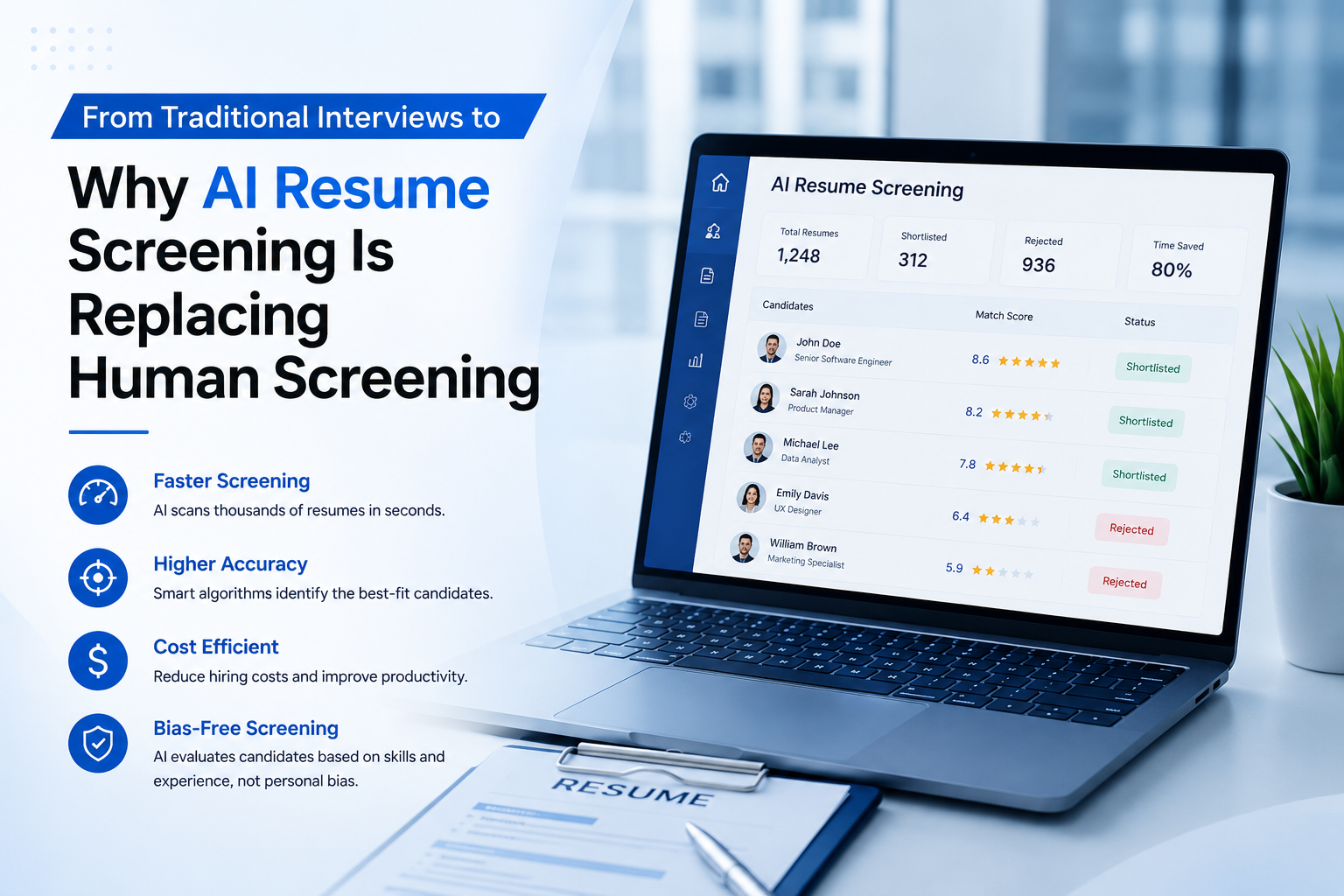
Artificial intelligence is transforming recruitment by helping hiring teams identify qualified candidates faster, more accurately, and more efficiently than ever before. As a result, AI resume screening is steadily replacing traditional human screening processes across industries.
The Traditional Resume Screening Process
To understand why AI is taking over, it's important to understand how traditional screening works.
In a conventional hiring process, recruiters manually review resumes and evaluate candidates based on factors such as:
- Work experience
- Technical skills
- Educational background
- Certifications
- Industry knowledge
- Career progression
While experienced recruiters can identify strong candidates, manual screening comes with several limitations.
Time-Consuming Workload
Recruiters often spend hours reviewing resumes for a single position.
Imagine receiving 1,000 applications for a software engineering role. Even if a recruiter spends only 30 seconds reviewing each resume, the screening process could take more than eight hours.
For organizations hiring across multiple positions, this workload becomes overwhelming.
Inconsistent Evaluation
Different recruiters may interpret resumes differently.
One recruiter might prioritize certifications, while another focuses on experience or educational qualifications. This inconsistency can affect candidate selection and create challenges in maintaining fair hiring standards.
Human Fatigue
Resume screening is repetitive work.
After reviewing hundreds of resumes, concentration naturally declines. Important details can be overlooked, and qualified candidates may accidentally be rejected.
Unconscious Bias
Even highly experienced recruiters can be influenced by unconscious biases.
Factors such as university names, previous employers, career gaps, or personal assumptions may impact screening decisions without recruiters realizing it.
These limitations have encouraged organizations to explore smarter alternatives.
What Is AI Resume Screening?
AI Resume Screening is a technology-driven process that uses artificial intelligence, machine learning, and natural language processing (NLP) to analyze resumes and identify suitable candidates.
Instead of manually reviewing every application, AI systems automatically evaluate resumes against predefined job requirements.
The technology can assess:
- Skills and competencies
- Job experience
- Education
- Certifications
- Industry-specific expertise
- Keywords and qualifications
- Role compatibility
Within seconds, AI can rank candidates based on how closely they match the job description.
This automation dramatically improves recruitment efficiency.
Why Companies Are Switching to AI Resume Screening
The growing popularity of AI resume screening is driven by several practical advantages.
Faster Hiring Processes
Speed has become a competitive advantage in recruitment.
Top candidates often receive multiple job offers. If companies take too long to review applications, they risk losing talent to competitors.
AI systems can analyze thousands of resumes within minutes.
This allows recruiters to move qualified candidates into the interview process much faster.
Better Candidate Matching
Modern AI tools do more than search for keywords.
Advanced systems analyze context, experience relevance, transferable skills, and overall job compatibility.
This improves candidate matching accuracy and helps recruiters discover strong applicants who might otherwise be overlooked.
Reduced Administrative Burden
Recruiters spend a significant portion of their time on repetitive tasks.
By automating resume screening, AI frees recruiters to focus on strategic hiring activities such as:
- Candidate engagement
- Interview preparation
- Employer branding
- Strategic hiring decisions
- Relationship building
This shift increases overall recruiter productivity.
Improved Scalability
High-volume recruitment presents unique challenges.
Organizations hiring hundreds or thousands of employees often struggle to review applications efficiently.
AI Resume Screening provides the scalability needed to handle large applicant pools without increasing recruitment costs.
Whether a company receives 100 applications or 10,000, AI can process them consistently and efficiently.
How AI Resume Screening Works
Although different platforms use different technologies, the process typically follows several key steps.
Step 1: Job Description Analysis
The AI system analyzes the job description and identifies key requirements.
This may include:
- Required skills
- Experience level
- Educational qualifications
- Certifications
- Industry expertise
Step 2: Resume Parsing
The system extracts information from resumes.
It identifies:
- Work history
- Skills
- Qualifications
- Achievements
- Keywords
Step 3: Candidate Scoring
AI compares candidate profiles against job requirements.
Each applicant receives a compatibility score based on predefined criteria.
Step 4: Candidate Ranking
The highest-scoring candidates are ranked and presented to recruiters for further review.
This process can be completed within minutes rather than days.
The Accuracy Advantage of AI
One of the biggest reasons organizations are embracing AI resume screening is accuracy.
Human recruiters may overlook strong candidates due to workload, time pressure, or fatigue.
AI systems remain consistent regardless of application volume.
They evaluate every candidate using the same criteria, helping organizations make more objective decisions.
This consistency often leads to better-quality shortlists and improved hiring outcomes.
AI Helps Reduce Hiring Bias
Diversity and inclusion have become major priorities for modern organizations.
Traditional screening methods sometimes allow unconscious bias to influence decisions.
When designed responsibly, AI evaluates candidates based on:
- Skills
- Experience
- Competencies
- Job-related qualifications
This creates a more equitable hiring process.
Industries Benefiting from AI Resume Screening
AI Resume Screening is now used across multiple industries.
Information Technology
Technology companies often receive large volumes of applications for engineering and development roles.
AI helps identify candidates with relevant technical skills quickly.
Healthcare
Hospitals and healthcare organizations use AI to screen medical professionals, administrators, and support staff.
Finance
Banks and financial institutions leverage AI to identify candidates with specialized certifications and industry expertise.
Retail and Hospitality
High-volume recruitment campaigns benefit significantly from automated screening.
Manufacturing
Organizations use AI to identify candidates with technical qualifications and operational experience.
Does AI Replace Recruiters?
A common misconception is that AI will replace recruiters.
In reality, AI is designed to assist recruiters rather than replace them.
AI excels at:
- Processing large datasets
- Screening resumes quickly
- Identifying patterns
- Ranking candidates
Recruiters remain essential for:
- Conducting interviews
- Assessing cultural fit
- Building relationships
- Evaluating soft skills
- Making final hiring decisions
The most effective hiring strategies combine AI efficiency with human expertise.
Challenges of Human-Only Screening in 2026 and Beyond
As hiring volumes continue to grow, organizations relying entirely on manual resume screening may face several challenges:
- Slower hiring cycles
- Increased recruitment costs
- Missed talent opportunities
- Recruiter burnout
- Inconsistent evaluations
AI addresses these issues while improving overall recruitment performance.
Companies that fail to adopt modern hiring technologies may struggle to compete in increasingly competitive talent markets.
The Future of Resume Screening
AI recruitment technology continues to evolve rapidly.
Future AI Resume Screening platforms are expected to include:
- Predictive hiring analytics
- Skill-gap analysis
- Candidate success forecasting
- Automated talent rediscovery
- Integration with AI interview tools
- Real-time recruitment insights
These innovations will further improve hiring efficiency and decision-making.
Organizations that embrace AI-powered recruitment today will be better prepared for the future of work.
Final Thoughts
The shift from human-only resume screening to AI Resume Screening represents a major evolution in modern recruitment.
Traditional screening methods, while valuable in the past, often struggle to keep up with today's hiring demands. High application volumes, tight hiring timelines, and increasing competition for talent require faster and more scalable solutions.
AI Resume Screening enables organizations to identify qualified candidates more quickly, reduce administrative workload, improve consistency, and support fairer hiring practices.
Rather than replacing recruiters, AI empowers them to focus on what matters most—building relationships, evaluating potential, and making informed hiring decisions.
As recruitment continues to evolve, AI resume screening is no longer a future trend. It is becoming the new standard for organizations that want to hire smarter, faster, and more effectively.