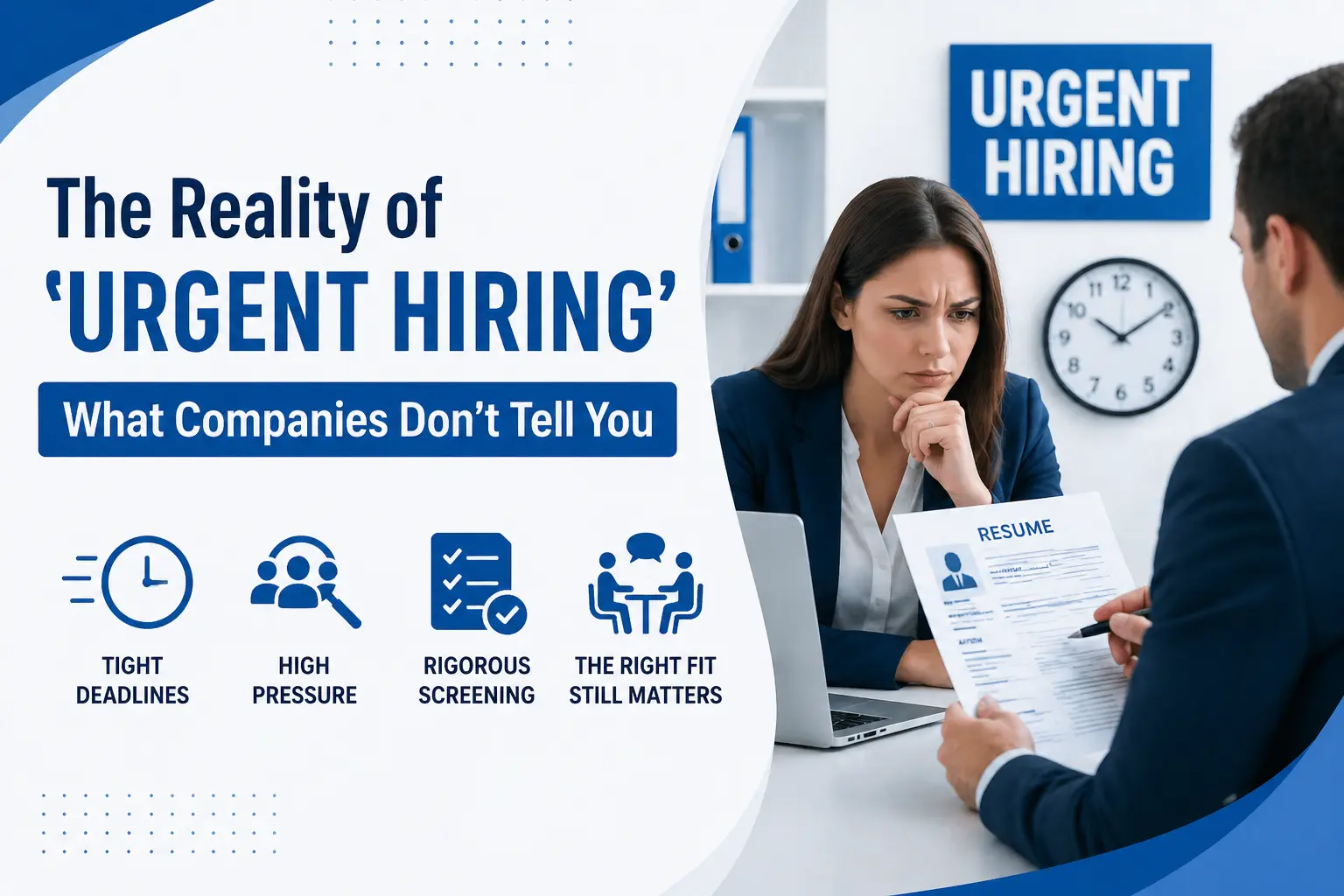
A Truth Most Candidates Misunderstand
"Urgent hiring" doesn't always mean you'll get hired faster.
Many candidates believe that when a job is marked as urgent hiring, it increases their chances of selection. It feels like companies are desperate to fill the role quickly.
But the reality is very different.
In most cases, urgent hiring is not about speed alone—it's about pressure, gaps, and sometimes confusion inside the organization.
Understanding the urgent hiring reality can completely change how you approach job applications and improve your chances of getting selected.
What Does Urgent Hiring Really Mean?
Understanding the Urgent Hiring Reality
When companies say "urgent hiring," it usually signals an internal problem that needs immediate attention.
This could be due to:
- A sudden employee exit
- Business expansion
- Project deadlines
- High workload pressure
However, urgency does not simplify the hiring process. In fact, it often makes it more complicated.
Urgent hiring reality is not about faster hiring—it's about faster decision pressure with the same expectations.
Why Companies Announce Urgent Hiring
The Business Side of Urgent Hiring Reality
Companies use the term "urgent hiring" for several strategic reasons.
1. To Attract More Applications Quickly
The word "urgent" creates a sense of opportunity. Candidates feel:
- Higher chances of selection
- Faster response
- Less competition
This increases the number of applications in a short time.
2. To Fill Critical Gaps
When a role directly impacts business operations, companies cannot afford delays. For example:
- Sales roles affecting revenue
- Technical roles affecting delivery
- Support roles affecting customer experience
Urgency comes from business need—not candidate convenience.
3. To Speed Up Internal Hiring Decisions
Sometimes, companies use urgency internally to push hiring managers to make quicker decisions.
However, even with urgency, companies still want the right candidate, not just any candidate.
The Hidden Truth: Urgent Hiring Is Still Selective
Why Urgent Doesn't Mean Easy
One of the biggest misconceptions is that urgent hiring lowers the hiring standards.
This is completely false.
Companies still evaluate:
- Skills
- Experience
- Cultural fit
- Salary expectations
In fact, urgency can make hiring stricter because companies cannot afford a wrong hire.
Why Candidates Still Get Rejected in Urgent Hiring
The Urgent Hiring Reality Explained
Even in urgent hiring situations, many candidates face rejection. This can feel confusing, but there are clear reasons behind it.
1. Mismatch Between Role and Profile
Even under pressure, recruiters look for relevance. If your profile doesn't match the job requirements, urgency won't help.
2. Too Many Applications
Urgent hiring often attracts a large number of applicants quickly. This increases competition instead of reducing it.
3. Lack of Clear Positioning
If your resume doesn't clearly show:
- Your role
- Your skills
- Your value
…it gets skipped, even in urgent hiring.
The Pressure Behind Urgent Hiring
What Companies Don't Tell You
Urgent hiring creates pressure not just for candidates—but also for recruiters and companies.
Recruiters face:
- Tight deadlines
- High expectations
- Large volumes of applications
Hiring managers face:
- Business pressure
- Team performance issues
- Risk of making a wrong hire
This pressure often leads to faster—but not always better—decisions.
The Role of AI Hiring Tools in Urgent Hiring
How Technology Supports Urgent Hiring Reality
In urgent hiring situations, companies increasingly rely on AI hiring tools to manage volume and speed.
These tools help:
- Screen resumes quickly
- Identify relevant candidates
- Reduce manual workload
However, automation also means:
If your resume is not optimized, it may never get seen.
Why Timing Matters More in Urgent Hiring
The First-Mover Advantage
In urgent hiring, timing plays a crucial role.
Recruiters often:
- Shortlist candidates within 24–48 hours
- Close roles quickly after finding suitable candidates
If you apply late, you may miss the opportunity—even if you are qualified.
How Candidates Should Approach Urgent Hiring
Smart Strategy to Win in Urgent Hiring Reality
Understanding urgent hiring reality allows you to approach it strategically.
1. Apply Quickly
Speed matters. Apply as soon as possible after the job is posted.
2. Customize Your Resume
Even in urgent hiring, relevance is key. Align your resume with:
- Job description
- Required skills
- Role expectations
3. Highlight Immediate Value
Companies want candidates who can:
- Start quickly
- Adapt fast
- Deliver results
Show that you can solve their problem immediately.
4. Be Ready for Fast Interviews
Urgent hiring often involves:
- Quick interview scheduling
- Faster decision-making
Be prepared to respond quickly.
The Risk of Wrong Hiring Decisions
When Urgency Backfires
Urgent hiring can sometimes lead to poor hiring decisions.
This happens when:
- Companies rush the process
- Proper evaluation is skipped
- Candidates are selected too quickly
A wrong hire can cost more than a delayed hire.
That's why companies still try to balance speed with accuracy.
The Difference Between Urgent Hiring and Bulk Hiring
Understanding the Hiring Context
Urgent hiring is often confused with bulk hiring, but they are different.
- Urgent hiring: Focused on filling a critical role quickly
- Bulk hiring: Focused on hiring multiple candidates at scale
Both use automation and fast processes, but urgency is driven by immediate need, not volume.
The Future of Urgent Hiring
Hiring is becoming faster and more technology-driven.
Future trends include:
- AI-powered candidate matching
- Real-time hiring decisions
- Automated screening processes
However, one thing will remain constant:
Companies will always prioritize the right fit over speed.
Final Truth About Urgent Hiring Reality
Urgent hiring is not about easy hiring—it's about pressured hiring.
Candidates who understand this have a clear advantage.
Conclusion
The term "urgent hiring" can be misleading if not understood correctly.
It does not guarantee:
- Faster selection
- Easier interviews
- Higher chances
Instead, it reflects:
- Business urgency
- Hiring pressure
- Need for quick but accurate decisions
To succeed, candidates must focus on speed, relevance, and clarity.
Because in the end, even in urgent hiring:
The best-fit candidate always wins.