A Bold Truth Most Candidates Ignore
"Skills matter more than degree."
You've heard this everywhere—LinkedIn posts, career coaches, influencers, and even recruiters.
But here's the uncomfortable truth:
This statement is not always true in real hiring scenarios.
Yes, skills are critical. But if you believe that skills alone will guarantee you a job, you're setting yourself up for disappointment.
Modern hiring is more complex. It involves degrees, skills, experience, hiring systems, and recruiter psychology—all working together.
In this blog, we break this myth and show you what really matters in today's hiring process.
The Popular Myth: Skills Over Degree
Why This Idea Became So Popular
The rise of:
- Online learning platforms
- Skill-based certifications
- Freelancing and gig economy
- Tech industry success stories
…has made people believe that degrees are becoming irrelevant.
And to some extent, that's true.
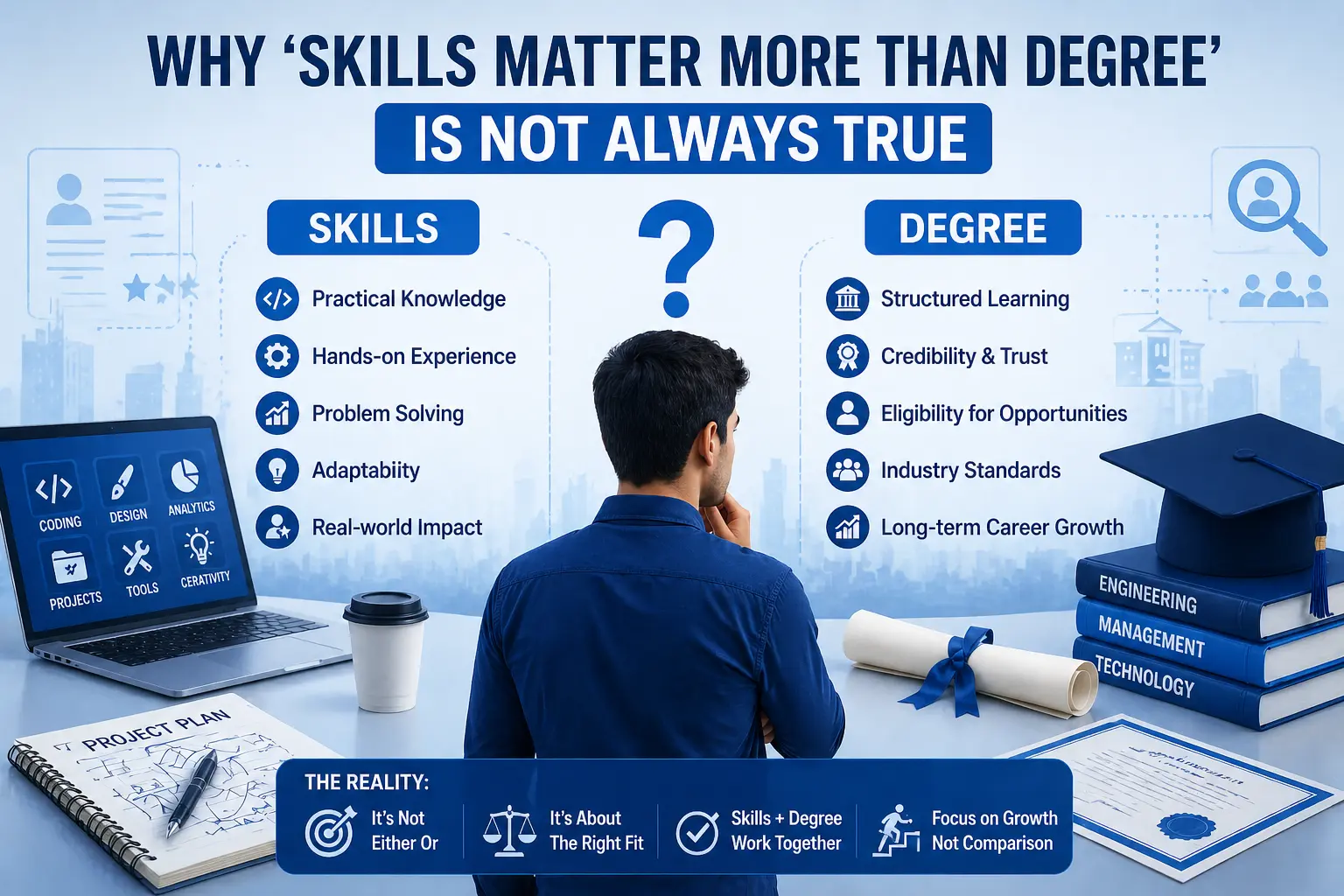
Many companies today value:
- Practical knowledge
- Hands-on experience
- Problem-solving ability
But this doesn't mean degrees have no value.
The Reality: Why Degrees Still Matter in Hiring
1. Degrees Act as a Screening Filter
In high-volume hiring, recruiters often use degrees as the first filter.
Why?
- It reduces the number of applicants quickly
- It ensures a basic level of education
- It simplifies shortlisting
In bulk hiring or fresher hiring, degree requirements are still very common.
2. Many Companies Still Require Degrees
Despite the "skills-first" narrative, many organizations—especially in:
- Engineering
- Healthcare
- Government jobs
- Large enterprises
…still require a formal degree.
In such cases, no matter how skilled you are, you may not even qualify to apply.
3. Degrees Build Trust and Credibility
A degree signals:
- Structured learning
- Discipline and commitment
- Foundational knowledge
For recruiters, this reduces risk. When choosing between two candidates, a degree can become a deciding factor.
When Skills Actually Matter More Than Degree
Let's be fair—there are many situations where skills matter more than degree.
1. In Startup Hiring
Startups prioritize:
- Speed
- Output
- Practical ability
They care less about formal education and more about what you can do and how fast you can deliver.
2. In Tech and Digital Roles
Fields like:
- Software development
- Digital marketing
- UI/UX design
…often value portfolios over degrees. Demonstrated skills can outweigh formal education here.
3. In Freelancing and Contract Hiring
Clients focus on:
- Results
- Experience
- Work samples
Degrees rarely matter in freelance hiring.
The Real Problem: Candidates Misunderstand Hiring
Skills vs Degree Is the Wrong Debate
The real hiring decision is not:
Skills vs Degree
It is:
Relevance + Fit + Visibility
Recruiters ask:
- Does this candidate match the role?
- Can they solve the company's problem?
- Do they fit the hiring criteria?
Both skills and degrees contribute to this answer.
The Role of AI Hiring Tools in Modern Recruitment
Today, hiring is no longer fully human-driven. Companies use AI recruitment tools, Applicant Tracking Systems (ATS), and automated screening software to manage hiring at scale.
What This Means for Candidates
Your profile is evaluated based on:
- Keywords
- Qualifications (including degree)
- Skills mentioned
- Experience relevance
If a job description includes a degree requirement, AI systems may filter you out automatically.
Why "Skills Alone" Can Fail You
1. Lack of Proof
Saying you have skills is not enough. Recruiters want:
- Certifications
- Projects
- Experience
Without proof, skills lose impact.
2. Poor Resume Positioning
Even skilled candidates fail because:
- Their resume lacks keywords
- Their achievements are unclear
- Their experience is not aligned
Skills must be presented effectively to matter.
3. High Competition
In today's hiring market:
- Thousands of candidates apply for one role
- Many have both skills AND degrees
If you only have skills, you may lose out.
Recruiter Reality: What Actually Influences Hiring
Let's break down real hiring factors:
Key Decision Drivers
- Skills relevance
- Educational background
- Experience level
- Resume quality
- Cultural fit
- Timing
Hiring is a combination—not a single factor decision.
The Hidden Power of Degree + Skills Together
The strongest candidates are not those who choose one over the other. They combine both.
Why This Works:
- Degree builds trust
- Skills prove capability
- Together, they create a strong profile
Smart Strategy for Candidates
Instead of debating skills vs degree, focus on this:
1. Build Skills That Match Market Demand
Focus on:
- Industry-relevant tools
- Practical experience
- Real-world projects
2. Use Certifications as Proof
If you don't have a degree:
- Add certifications
- Build a portfolio
- Show measurable results
3. Optimize Your Resume for AI Hiring
Include:
- Relevant keywords
- Clear structure
- Role-specific content
This increases your chances of passing ATS screening and getting noticed by recruiters.
4. Apply Strategically
Don't apply randomly. Target:
- Jobs where your profile aligns
- Companies open to skill-based hiring
How AI Recruitment Tools Are Changing This Debate
AI hiring tools are shifting hiring from opinion-based to data-driven.
Benefits for Recruiters:
- Faster screening
- Better matching
- Reduced bias
Benefits for Candidates:
- More transparent evaluation
- Skill-based scoring (in some cases)
But degree filters still exist in many systems.
The Truth Candidates Need to Accept
"Skills matter more than degree" is not always true.
The real truth is:
- Skills matter
- Degrees matter
- Presentation matters
- Technology matters
Ignoring any one of these can hurt your chances.
Final Solution: How to Win in Modern Hiring
If you want to succeed in today's hiring world:
- ✔ Combine Skills + Credentials
- ✔ Optimize for AI recruitment systems
- ✔ Position yourself strategically
- ✔ Focus on relevance, not just qualifications
Looking Ahead
Modern hiring is no longer simple—it's driven by data, speed, and technology.
That's why companies are adopting AI hiring tools and recruitment automation platforms to make smarter decisions.
And candidates who understand this shift—and adapt to it—are the ones who win.
Conclusion
The debate of skills vs degree is outdated.
The future of hiring belongs to those who:
- Understand recruiter behavior
- Align with job requirements
- Adapt to AI-driven hiring systems
Because in reality, it's not about choosing one—it's about using both strategically.
Ready to Transform Your Hiring Process with AI?
Connect with Easy Hire Tools today and experience smarter, faster, and more accurate recruitment!
Get Started Today →