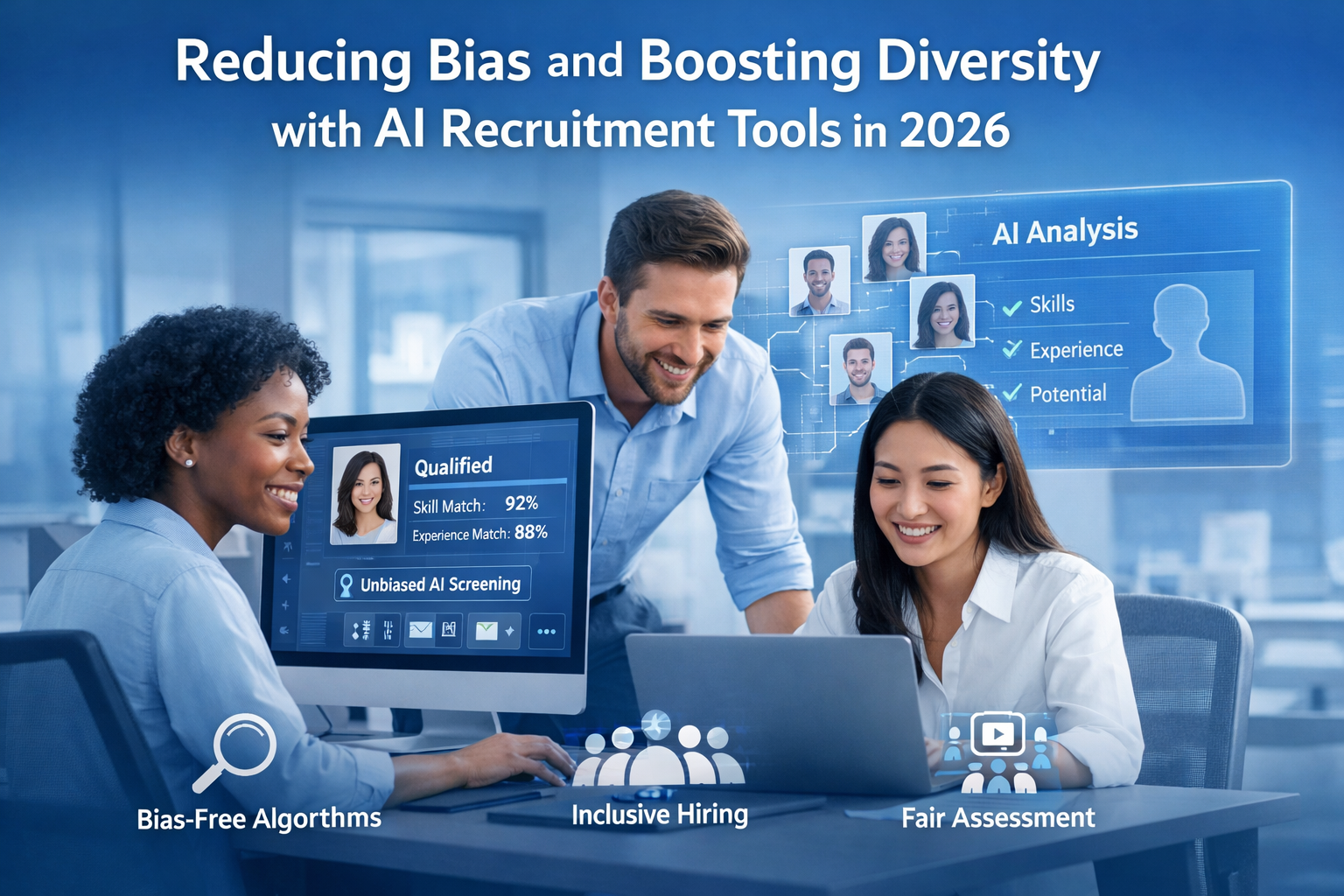
In 2026, building a diverse and inclusive workforce is no longer just a corporate responsibility—it's a competitive necessity. Organizations increasingly recognize that diverse teams drive innovation, improve decision-making, and enhance business performance. However, the path to equitable hiring remains challenging due to unconscious bias, outdated recruitment practices, and systemic inequities embedded in traditional hiring processes.
This is where artificial intelligence in recruitment becomes transformative. Advanced AI recruitment tools are revolutionizing how organizations approach diversity and inclusion by systematically reducing bias, expanding candidate pools, and creating fair, evidence-based hiring decisions. From AI-powered candidate screening to structured interview frameworks, these technologies are enabling companies to build genuinely diverse teams while ensuring merit-based selection.
This comprehensive guide explores how AI recruitment tools reduce bias, boost diversity, and foster inclusive hiring practices in 2026—with practical strategies you can implement immediately.
Understanding Bias in Traditional Recruitment
Before diving into AI solutions, it's essential to understand the types of bias that plague traditional recruitment:
1. Unconscious Bias in Resume Screening
Even well-intentioned recruiters bring unconscious biases to resume screening. Studies show that identical resumes with names suggesting certain ethnic backgrounds receive fewer callbacks. Similarly, applicants with longer employment gaps, unconventional career paths, or non-traditional educational backgrounds face discrimination—often without recruiters realizing it.
2. Homophily Bias (The "Like Me" Bias)
Recruiters tend to favor candidates who resemble them in background, education, or communication style. This perpetuates demographic homogeneity and prevents organizations from accessing diverse talent pools, ultimately limiting innovation and perspective.
3. Confirmation Bias
Once a recruiter forms an initial impression of a candidate, they tend to seek information confirming that impression while ignoring contradictory evidence. This selective attention reduces the quality of hiring decisions and margins out qualified candidates who don't fit preconceived notions.
4. Anchoring Bias
Recruiters often overweight the first information they receive about a candidate, whether it's the school they attended or their previous salary. This anchoring effect can prematurely eliminate strong candidates or advance weak ones based on superficial signals.
5. Affinity Bias
People naturally gravitate toward those with shared interests, backgrounds, or demographics. In hiring, this creates self-perpetuating cycles where senior leaders, often from majority demographics, unconsciously prefer candidates similar to themselves.
How AI Recruitment Tools Combat Bias
Objective Criteria-Based Screening
AI recruitment tools analyze resumes against predefined, objective job requirements—not demographic characteristics. When properly configured, AI screening systems focus exclusively on skills, experience, competencies, and relevant qualifications, removing subjective human judgment from initial filtering stages.
Example: Rather than a recruiter eyeballing resumes, an AI system evaluates candidates against measurable criteria: required certifications, years of experience in specific technical skills, relevant project examples, and demonstrated competencies. Each candidate receives a consistent evaluation framework.
Blind Resume Processing
Advanced AI tools can remove personally identifiable information (name, age, gender, graduation date) before candidate profiles reach human reviewers. By presenting candidates as skill sets and experience summaries rather than names and photos, AI creates a "blind audition" effect similar to orchestras that famously improved diversity through this method.
This approach has been proven to increase callback rates for underrepresented candidates by up to 50% in some studies.
Expanded Candidate Sourcing
Traditional recruiting often relies on networks and channels that perpetuate existing demographics. AI candidate sourcing, by contrast, scans diverse job boards, professional networks, alternative education credentials, and underutilized talent pools—reaching candidates your traditional sourcing would never encounter.
Example: An AI sourcing tool identifies a qualified data analyst who attended a coding bootcamp rather than a traditional four-year university, completed a career transition, or took a career break to raise children. Traditional recruiters might overlook this candidate; AI surfaces them based on demonstrated skills.
Mitigation of AI Bias Through Auditing
While AI can amplify bias if trained on biased historical data, modern recruitment AI tools include bias detection and mitigation features. These systems:
- Regularly audit AI decisions against demographic breakdowns to identify disparate impact
- Flag patterns where certain groups are systematically ranked lower despite comparable qualifications
- Allow recruiters to adjust algorithms to ensure equitable outcomes across demographic groups
- Provide transparency reports showing how candidates of different backgrounds are distributed across screening stages
This level of accountability fundamentally differs from traditional recruiting, where bias remains invisible and unchecked.
Structured Interview Frameworks
AI-powered interview platforms can standardize interview experiences by:
- Asking every candidate the same questions in the same sequence
- Providing interview guides that focus on job-relevant competencies, not small talk or cultural fit signals
- Recording and analyzing interviews to ensure consistent evaluation
- Reducing the impact of interviewer charm, communication style, or rapport on hiring decisions
By removing subjective "gut feeling" from interviews, AI ensures that introverted candidates, those with different communication styles, or individuals from unfamiliar cultural backgrounds are evaluated fairly on actual competency.
Building Diversity with AI: Practical Strategies
Strategy 1: Define Diversity Metrics and Goals
Before implementing AI recruitment tools, establish clear diversity goals. What does diversity mean for your organization? What metrics matter (gender, ethnicity, age, educational background, geography, veteran status, disability inclusion)?
Document these goals and use AI analytics dashboards to track progress. This transforms diversity from a vague aspiration into measurable outcomes with accountability.
Strategy 2: Use AI to Expand Sourcing Channels
Task your AI recruitment tool to actively source from underrepresented talent pools:
- Companies and bootcamps serving underrepresented communities
- Professional networks focused on women, minorities, or other underrepresented groups (without discriminating)
- Alternative credential paths (coding bootcamps, apprenticeships, certificate programs)
- Career returners and non-traditional backgrounds
Expanded sourcing doesn't just improve diversity; it also widens your talent pool and helps address skill shortages in competitive markets.
Strategy 3: Implement Blind Screening and Unbiased Resume Review
Configure your AI tool to strip identifying information from resumes before initial screening. This single step removes many vectors of bias and forces evaluation to focus on qualifications.
Pro Tip: Maintain diverse review panels even with AI screening. When human judgment enters the process (e.g., final interviews, hiring decisions), ensure decision-makers include people from different backgrounds and perspectives.
Strategy 4: Use Candidate Avatar Tools for Inclusive Job Definition
Before sourcing candidates, use an AI candidate avatar tool to collaboratively define the ideal candidate profile. This process forces teams to clarify core competencies versus nice-to-haves, distinguish truly required qualifications from gatekeeping preferences, and create alignment across hiring stakeholders.
By being intentional about what actually matters for job success, you eliminate arbitrary requirements (like "must have attended a top-tier university") that disproportionately exclude diverse candidates.
Strategy 5: Audit for Disparate Impact
Regularly analyze your AI recruitment system's outcomes across demographic groups. Watch for patterns like:
- Certain groups advancing at lower rates than others
- Requirements that disproportionately exclude protected classes
- Interview advancement rates that vary significantly by demographic
If disparate impact is detected, investigate root causes (biased training data, poorly defined job requirements, algorithmic issues) and adjust. This continuous auditing ensures your AI becomes more equitable over time.
Strategy 6: Create Inclusive Interview and Onboarding Experiences
AI can standardize interviews, but inclusion extends beyond hiring. Use AI-powered systems to:
- Provide candidates accessibility accommodations without awkward requests
- Offer interview preparation resources to candidates from underrepresented backgrounds
- Create transparent communication about role expectations and company culture
- Automate welcoming communication and onboarding checklists
Candidates from underrepresented groups often face imposter syndrome or anxiety in new environments. Reducing friction and increasing support helps them succeed.
Real-World Impact: 2026 Success Stories
Case Study 1: Tech Company Expanding Engineer Diversity
A fast-growing tech company used AI recruitment tools to increase female engineers from 15% to 32% of their engineering team within two years. By expanding sourcing to include coding bootcamp graduates and returning professionals, implementing blind resume screening, and removing unnecessary degree requirements, they accessed a more diverse talent pool while improving hiring speed by 40%.
Case Study 2: Financial Services Improving Racial Equity
A financial services firm implemented AI-powered candidate screening and discovered their traditional process was biased—certain applicant names received fewer callbacks despite identical qualifications. After implementing fair AI screening, standardized interviews, and expanded sourcing, the percentage of Black and Latino hires in professional roles increased by 45% in the first year, while overall hire quality improved.
Case Study 3: Healthcare Organization Building Inclusive Teams
A healthcare network used an AI candidate avatar tool to intentionally define inclusive hiring criteria that valued diverse backgrounds and perspectives. By eliminating unnecessary educational gatekeeping and sourcing from non-traditional pathways, they built clinical teams more reflective of the diverse patient populations they serve—improving patient trust and cultural competency in care delivery.
Best Practices for Implementing Bias-Reducing AI in Recruitment
- Partner with Diversity Experts: Work with diversity, equity, and inclusion (DEI) professionals when configuring AI systems. Their expertise helps ensure the technology actually advances your diversity goals.
- Maintain Transparency: Clearly communicate to candidates how AI is being used in your recruitment process. Transparency builds trust and helps underrepresented candidates feel comfortable participating.
- Don't Automate Everything: Use AI to reduce bias in screening and initial filtering, but maintain human judgment in final decisions. AI is a tool to support fairness, not replace human responsibility for equity.
- Monitor Outcomes Continuously: Track hiring outcomes, promotion rates, and retention across demographic groups. Use this data to continuously improve your hiring process.
- Address Systemic Issues: Remember that recruitment is only one part of equity. Even with perfect hiring, biased promotion practices, pay inequity, or unwelcoming workplace culture will undermine diversity efforts. Address these systemic issues in parallel.
- Invest in Employee Resources: For underrepresented employees who do get hired, provide mentorship, sponsorship, and employee resource groups (ERGs) to support retention and career advancement.
The Future of Equitable Recruitment in 2026 and Beyond
As we move through 2026, the competitive disadvantage of biased hiring is becoming impossible to ignore. Companies with diverse teams consistently outperform their peers on innovation, financial performance, and employee engagement. Meanwhile, talent from underrepresented groups increasingly has options and gravitates toward inclusive employers.
The convergence of legal pressure (increased employment litigation around bias), business pressure (talent war requiring access to all qualified candidates), and ethical pressure (growing societal expectations around equity) means that equitable AI recruitment isn't a nice-to-have—it's essential.
The tools exist. What's required now is organizational commitment to using them intentionally, auditing continuously, and integrating diversity into your talent acquisition strategy from the very beginning.
Getting Started with Bias-Reducing AI Recruitment Tools
Ready to make your recruitment more fair, diverse, and inclusive? Start here:
- Assess your current recruitment process for sources of bias
- Define diversity goals and metrics
- Research AI recruitment tools that include bias detection and mitigation features
- Implement blind screening and objective job requirement frameworks
- Expand your sourcing to reach diverse talent pools
- Monitor outcomes and continuously adjust your approach
Easy Hire Tools provides comprehensive AI recruitment solutions, including candidate avatar tools and AI-powered screening that helps organizations reduce bias while building genuinely diverse teams. Our platform helps you define ideal candidate profiles, source from diverse channels, and make fair, objective hiring decisions.
In 2026, diverse, inclusive hiring isn't just the right thing to do—it's the smart competitive move. AI recruitment tools make it achievable.
Conclusion
Reducing bias and boosting diversity in recruitment requires intentional strategy, transparent processes, and the right tools. AI, when properly implemented and continuously audited, creates a more fair, equitable, and effective hiring process while dramatically expanding your access to talent.
The future of recruitment is diverse, and it's powered by fair, intelligent hiring technology. Your organization can lead this transformation—starting today.