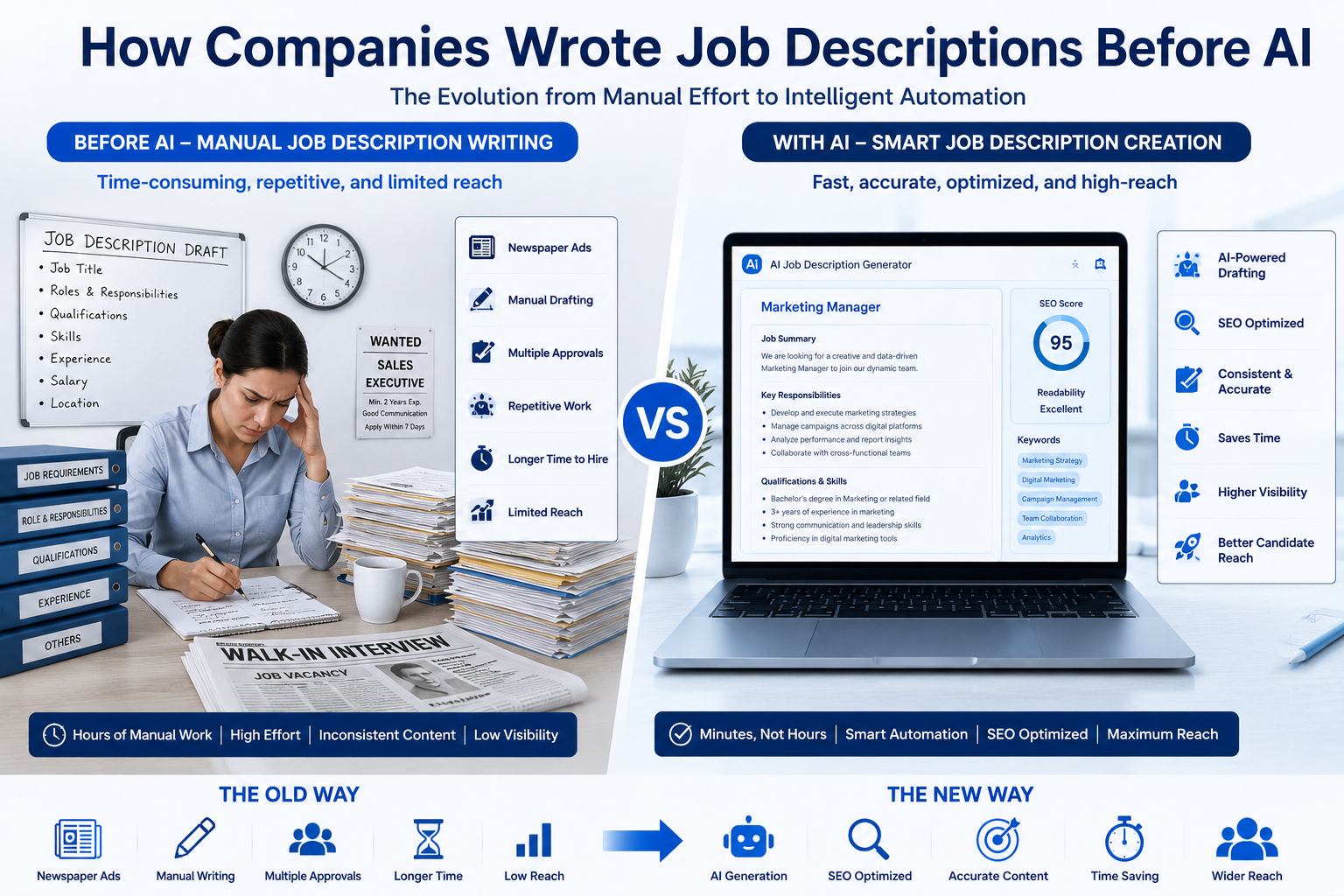
There was a time when writing a job description was a slow and completely manual process. HR professionals spent hours creating hiring ads, editing role responsibilities, and rewriting the same information repeatedly for different job openings.
In the ancient recruitment era, companies relied heavily on newspaper advertisements, printed hiring notices, emails, spreadsheets, and traditional HR documentation. Writing a job description was not just about listing responsibilities — it involved coordination between managers, HR teams, recruiters, and department heads.
Fast forward to 2026, and the process looks entirely different.
Today, AI-powered job description generators can create SEO-optimized, engaging, and highly targeted job descriptions within seconds. Businesses are using AI recruitment tools to attract better candidates, improve hiring speed, and automate repetitive HR tasks.
The shift from manual job descriptions to AI-generated hiring content represents one of the biggest changes in modern recruitment.
In this blog, we will explore how companies wrote job descriptions before AI, the problems with traditional recruitment content creation, and how AI job description generators are transforming hiring in 2026.
Ancient Recruitment: How Companies Wrote Job Descriptions Before AI
The Traditional Hiring Era
Before AI recruitment tools existed, creating a job description was a lengthy process. HR departments usually followed a manual workflow:
- Discuss role requirements with managers
- Create a draft manually
- Edit qualifications and responsibilities
- Add salary and company details
- Post the job on newspapers or job portals
This process consumed significant time and effort.
Newspaper Job Advertisements
In ancient recruitment systems, newspaper advertisements were one of the most common hiring methods.
Companies purchased classified ad space to publish job openings for sales executives, engineers, accountants, customer support agents, and administrative staff.
Because newspaper space was expensive, job descriptions were often short and limited. A traditional newspaper hiring ad included:
- Job title
- Experience required
- Qualification
- Contact number
- Office address
There was very little detail about company culture, skills, or growth opportunities. This made hiring less effective.
How HR Teams Created Job Descriptions Manually
Multiple Meetings and Approvals
Writing a job description earlier required discussions between HR teams, hiring managers, department heads, and recruitment agencies. Every department had different expectations, which slowed the process.
HR professionals manually collected required skills, educational qualifications, experience levels, technical requirements, and job responsibilities. Then they converted everything into a formal job description document.
Copy-Paste Recruitment
One common issue in traditional recruitment was repetitive copy-paste job descriptions. Many companies reused old templates for years without updating skills, technology requirements, market trends, or candidate expectations.
As a result, many job posts became outdated and unattractive.
Job Portals Changed Hiring
As digital recruitment platforms became popular, companies started posting jobs online. However, even with job portals, HR teams still created job descriptions manually.
Recruiters had to write content themselves, add keywords manually, format responsibilities, and upload openings individually. This created inconsistency in hiring communication.
Problems with Traditional Job Description Writing
Although manual job descriptions worked in the past, they created several recruitment challenges.
Time-Consuming Process
Writing every job description manually required significant effort. Recruiters often spent hours drafting content, editing responsibilities, formatting job posts, and updating hiring requirements.
For companies hiring multiple roles, this became exhausting.
Poor SEO Optimization
Traditional job descriptions were not optimized for search engines. Many HR teams did not understand SEO keywords, search intent, Google ranking factors, or candidate search behavior.
As a result:
- Job posts received low visibility
- Candidate reach decreased
- Hiring speed slowed down
Today, SEO-optimized job descriptions are critical for recruitment success.
Generic Hiring Content
Many companies used boring and repetitive hiring language such as:
- "We are looking for a dynamic candidate"
- "Must have excellent communication skills"
- "Good team player required"
These phrases failed to attract modern candidates. Traditional hiring ads lacked personalization, brand voice, and candidate engagement.
Inconsistent Job Descriptions
Different recruiters often wrote job descriptions differently for similar roles. This created inconsistency in hiring standards, skill expectations, and candidate communication.
Modern AI hiring systems solve this problem through standardized automation.
Slow Recruitment Workflows
Manual job description creation delayed recruitment campaigns. When hiring managers requested urgent hiring, HR teams struggled to create content quickly, get approvals, and publish openings fast.
This increased time-to-hire significantly.
Rise of AI Job Description Generators
The recruitment industry changed dramatically with the introduction of AI hiring tools. One of the most impactful innovations in recruitment automation is the AI job description generator.
Modern companies now use AI-powered systems to create professional hiring content instantly.
What is an AI Job Description Generator?
An AI job description generator is a recruitment tool that automatically creates job descriptions using artificial intelligence, machine learning, recruitment data, SEO optimization, and hiring trends.
Instead of manually writing every section, recruiters simply enter:
- Job title
- Skills required
- Experience level
- Industry
- Location
The AI system then generates a complete, optimized job description within seconds.
How AI Job Description Generators Work
Modern AI recruitment platforms analyze job market trends, candidate search behavior, industry keywords, and hiring patterns to create highly effective job descriptions.
AI systems automatically generate:
- Job summaries
- Key responsibilities
- Skills required
- Qualifications
- SEO keywords
- Company culture descriptions
This saves recruiters enormous amounts of time.
Benefits of AI Job Description Generators
Faster Recruitment
AI can generate professional job descriptions instantly. This helps companies launch recruitment campaigns faster.
SEO-Optimized Hiring Content
Modern AI tools create job descriptions optimized for:
- Google rankings
- Job portal visibility
- Candidate search intent
This increases candidate reach significantly.
Better Candidate Engagement
AI-generated content feels more professional, more personalized, more engaging, and easier to read. This improves application rates.
Consistent Hiring Communication
AI systems maintain standardized formatting and language across all job openings. This improves employer branding.
Reduced HR Workload
Recruiters no longer need to spend hours writing repetitive content. AI automates the process efficiently.
Ancient vs Latest Recruitment Trends
Ancient Recruitment Trends
Traditional hiring relied heavily on:
- Newspaper advertisements
- Manual documentation
- HR phone calls
- Generic job posts
- Physical interviews
- Spreadsheet tracking
The process was slower and less scalable.
Latest Recruitment Trends in 2026
Modern recruitment now depends on:
- AI job description generators
- AI resume screening
- AI voice agents
- Recruitment automation
- AI hiring analytics
- Candidate scoring systems
- Automated interview scheduling
Recruitment has become faster, smarter, and more data-driven.
Why AI is Replacing Manual Recruitment Content
The modern hiring market is highly competitive. Companies need faster hiring, better visibility, improved candidate experience, and smarter recruitment strategies.
Manual job description writing can no longer keep up with these demands. AI recruitment tools help businesses save time, reduce costs, improve hiring quality, and increase application rates.
This is why AI hiring technology is becoming essential in 2026.
Why Startups and Enterprises Are Using AI Hiring Tools
Startups Need Speed
Startups often hire rapidly. AI recruitment tools help startups create job posts instantly, launch campaigns faster, reduce HR workload, and scale recruitment efficiently.
Enterprises Need Recruitment Automation
Large companies manage multiple job openings daily. AI job description generators help enterprises standardize hiring communication, improve recruitment efficiency, maintain employer branding, and reduce operational costs.
This is why AI recruitment adoption is growing globally.
Future of Job Description Writing in 2030
The future of recruitment content will become even more intelligent. By 2030, AI systems may:
- Generate personalized job descriptions automatically
- Optimize hiring ads in real time
- Analyze candidate engagement instantly
- Create multilingual recruitment content
- Predict hiring performance through AI analytics
Recruitment marketing will become highly automated and data-driven.
Why Easy Hire Tools is the Future of Recruitment
Easy Hire Tools helps businesses modernize recruitment using AI-powered hiring solutions. The platform provides advanced recruitment automation features designed for modern HR teams.
Key Features of Easy Hire Tools
AI Job Description Generator: Create professional, SEO-optimized job descriptions instantly.
AI Resume Screening: Analyze and shortlist candidates efficiently.
AI Interview Automation: Conduct interviews using AI voice agents and automated workflows.
Recruitment Analytics: Track recruitment performance with intelligent hiring dashboards.
Candidate Comparison Tools: Compare applicants using AI-powered scoring systems.
Easy Hire Tools helps startups, enterprises, staffing agencies, and recruiters build faster and smarter hiring systems.
Final Thoughts
The way companies write job descriptions has changed dramatically. In the ancient hiring era, recruiters depended entirely on manual processes, newspaper advertisements, repetitive templates, and traditional HR workflows.
Creating a job description required time, coordination, and significant effort. In 2026, AI-powered job description generators are transforming recruitment completely.
Businesses now use intelligent recruitment systems to create SEO-friendly, engaging, and optimized hiring content within seconds.
The shift from manual job descriptions to AI-generated recruitment content is part of the larger evolution of AI hiring technology.
Companies that embrace AI recruitment tools today will gain a major competitive advantage in attracting top talent faster and more efficiently. And platforms like Easy Hire Tools are helping businesses lead the future of smart hiring.
FAQs
1. How did companies write job descriptions before AI?
Companies manually created job descriptions using HR meetings, templates, newspaper ads, and job portal postings.
2. What is an AI job description generator?
An AI job description generator automatically creates optimized hiring content using artificial intelligence and recruitment data.
3. Why are AI job description tools important?
AI tools save time, improve SEO optimization, increase candidate engagement, and streamline recruitment workflows.
4. How does AI improve recruitment content?
AI creates professional, readable, and keyword-optimized job descriptions tailored to candidate search intent.
5. What problems existed with traditional job descriptions?
Traditional job descriptions were time-consuming, inconsistent, repetitive, and poorly optimized for online visibility.
6. Can AI replace HR professionals completely?
No. AI supports recruiters by automating repetitive tasks, but human decision-making remains essential.
7. Why do startups use AI recruitment tools?
Startups use AI recruitment tools to hire faster, reduce costs, and scale recruitment efficiently.
8. What industries use AI hiring tools?
Industries such as IT, healthcare, retail, BPO, ecommerce, and staffing use AI recruitment extensively.
9. How does SEO help job descriptions?
SEO improves job post visibility on Google and job portals, helping companies attract more candidates.
10. What is recruitment automation?
Recruitment automation uses AI and software tools to automate hiring tasks like screening, scheduling, and communication.
11. What is the future of AI recruitment?
The future of AI recruitment includes predictive hiring, automated interviews, personalized hiring journeys, and intelligent analytics.
12. Why is Easy Hire Tools useful for recruiters?
Easy Hire Tools helps recruiters automate hiring, create optimized job descriptions, screen candidates, and improve recruitment efficiency.
Ready to Transform Your Hiring Process?
Connect with Easy Hire Tools today and experience the power of AI-driven recruitment!
Get Started Today →