The Era of Traditional Interviews
Imagine a hiring manager in the early 2000s preparing for an interview. A position opens within the company, resumes begin arriving, and the recruitment team starts the lengthy process of screening candidates.
Once shortlisted, interviewers manually prepare a list of questions. Often, these questions are based on personal experience, previous interviews, or templates stored in spreadsheets and documents.
While this process worked, it came with several challenges:
Time-Consuming Preparation
Creating relevant interview questions for every role required significant effort. Recruiters often spent hours researching job responsibilities and designing questions that could effectively assess candidates.
Inconsistent Interview Experiences
Different interviewers frequently asked different questions for the same role. This inconsistency made it difficult to compare candidates fairly.
Human Bias
Traditional interviews often relied heavily on personal judgment. Unconscious bias could influence question selection, evaluation methods, and hiring decisions.
Limited Scalability
When organizations needed to hire dozens or hundreds of employees, manually preparing interview questions became increasingly difficult.
As businesses expanded and competition for talent intensified, recruiters needed a smarter solution.
The Digital Transformation of Recruitment
The first wave of recruitment technology introduced Applicant Tracking Systems (ATS), online job portals, and automated scheduling tools.
These innovations reduced administrative work but left one major challenge unresolved: interview preparation.
Recruiters still spent considerable time creating role-specific questions and ensuring interview quality.
As artificial intelligence entered the recruitment industry, organizations began exploring ways to automate and improve interview preparation.
This led to the development of AI Interview Question Generators.
What Is an AI Interview Question Generator?
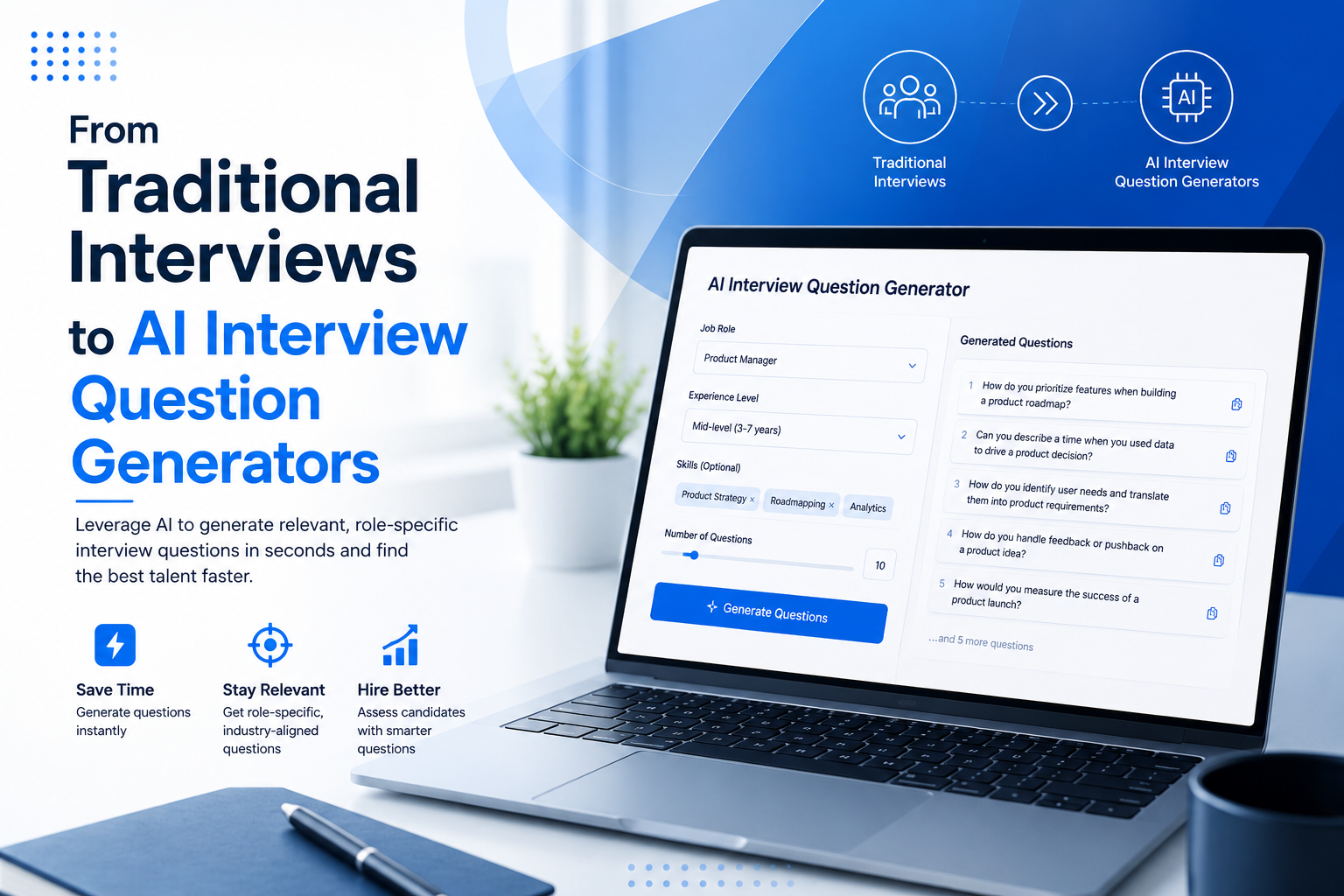
An AI Interview Question Generator is a recruitment tool that automatically creates relevant interview questions based on specific job roles, skills, industries, and experience levels.
Instead of manually drafting questions, recruiters simply provide information such as:
- Job title
- Required skills
- Experience level
- Industry
- Department
- Technical requirements
The AI then generates structured interview questions within seconds.
These questions can include:
- Behavioral questions
- Technical questions
- Situational questions
- Leadership assessments
- Soft skill evaluations
- Problem-solving scenarios
This significantly reduces preparation time while improving interview consistency.
Why Traditional Interview Preparation Is Becoming Outdated
Modern hiring environments move much faster than they did a decade ago.
Companies today face challenges such as:
- High-volume hiring
- Remote recruitment
- Global talent acquisition
- Skills shortages
- Competitive hiring markets
Traditional interview preparation struggles to keep pace with these demands.
Speed Matters More Than Ever
Top candidates often receive multiple job offers.
If recruiters spend days preparing interview materials, companies risk losing qualified candidates to competitors.
AI Interview Question Generators help organizations respond quickly by producing interview frameworks almost instantly.
Consistency Improves Hiring Quality
One of the biggest advantages of AI-generated interview questions is standardization.
When every candidate is evaluated using similar criteria, hiring teams can make more objective comparisons.
This improves fairness and reduces decision-making inconsistencies.
Better Alignment with Job Requirements
AI tools analyze job descriptions and skill requirements to create highly relevant questions.
Instead of relying on generic templates, recruiters receive customized questions tailored to the role.
This results in more meaningful candidate evaluations.
How AI Interview Question Generators Work
Modern AI-powered recruitment tools use natural language processing, machine learning, and job-specific data to create interview content.
The process typically involves:
Step 1: Job Analysis
The AI reviews the job description and identifies key competencies.
Step 2: Skill Identification
Critical technical and soft skills are extracted from the role requirements.
Step 3: Question Generation
The system generates role-specific questions designed to assess those skills.
Step 4: Interview Structuring
Questions are organized into categories such as:
- Technical evaluation
- Behavioral assessment
- Cultural fit
- Leadership potential
- Communication skills
The result is a comprehensive interview guide ready for immediate use.
Benefits of AI Interview Question Generators
1. Saves Significant Time
Recruiters can generate interview questions in minutes rather than hours.
This allows hiring teams to focus on candidate engagement and decision-making.
2. Reduces Bias
AI-generated question sets help create standardized interviews that reduce subjective influences.
Consistent questioning improves fairness across all candidates.
3. Enhances Candidate Evaluation
Well-structured questions reveal deeper insights into a candidate's experience, skills, and problem-solving abilities.
This leads to better hiring decisions.
4. Supports High-Volume Recruitment
Organizations conducting large-scale hiring can quickly create interview frameworks for multiple positions.
This scalability is especially valuable for startups, staffing agencies, and enterprise organizations.
5. Improves Recruiter Productivity
Automation eliminates repetitive tasks and allows recruiters to spend more time on strategic hiring activities.
AI Interview Question Generators Across Different Industries
AI-powered interview preparation is no longer limited to technology companies.
Today, businesses across multiple industries use AI-driven recruitment tools.
Information Technology
Technical assessments, coding questions, and problem-solving scenarios can be generated automatically.
Healthcare
Role-specific questions help evaluate medical professionals, administrative staff, and healthcare specialists.
Finance
AI can generate questions related to compliance, risk management, financial analysis, and customer service.
Manufacturing
Recruiters can assess technical skills, safety knowledge, and operational expertise.
Sales and Marketing
Behavioral and performance-based questions help evaluate communication and persuasion abilities.
Human Recruiters Still Matter
Despite rapid advancements in AI, technology does not replace human judgment.
AI Interview Question Generators serve as powerful assistants rather than replacements.
Recruiters continue to play a vital role in:
- Understanding company culture
- Building candidate relationships
- Evaluating emotional intelligence
- Assessing team fit
- Making final hiring decisions
The most successful organizations combine AI efficiency with human expertise.
The Future of Interview Preparation
The evolution of AI in recruitment is only beginning.
Future AI Interview Question Generators may offer:
- Real-time interview recommendations
- Predictive hiring insights
- Candidate-specific question customization
- Voice-based interview assistance
- Automated scoring systems
- Integration with recruitment CRM platforms
These innovations will further streamline hiring while improving candidate experiences.
Organizations that embrace AI-powered recruitment technologies today will be better positioned to compete for top talent tomorrow.
Final Thoughts
The transition from traditional interviews to AI Interview Question Generators represents one of the most significant advancements in modern recruitment.
Traditional interview preparation, while effective in the past, often struggles to meet the speed, consistency, and scalability demands of today's hiring environment.
AI Interview Question Generators help recruiters create better interviews, evaluate candidates more objectively, and significantly reduce preparation time. Rather than replacing recruiters, these tools empower hiring professionals to focus on strategic decision-making and meaningful candidate interactions.
As recruitment continues to evolve, organizations that combine human expertise with AI-driven efficiency will gain a powerful advantage in attracting and hiring exceptional talent.