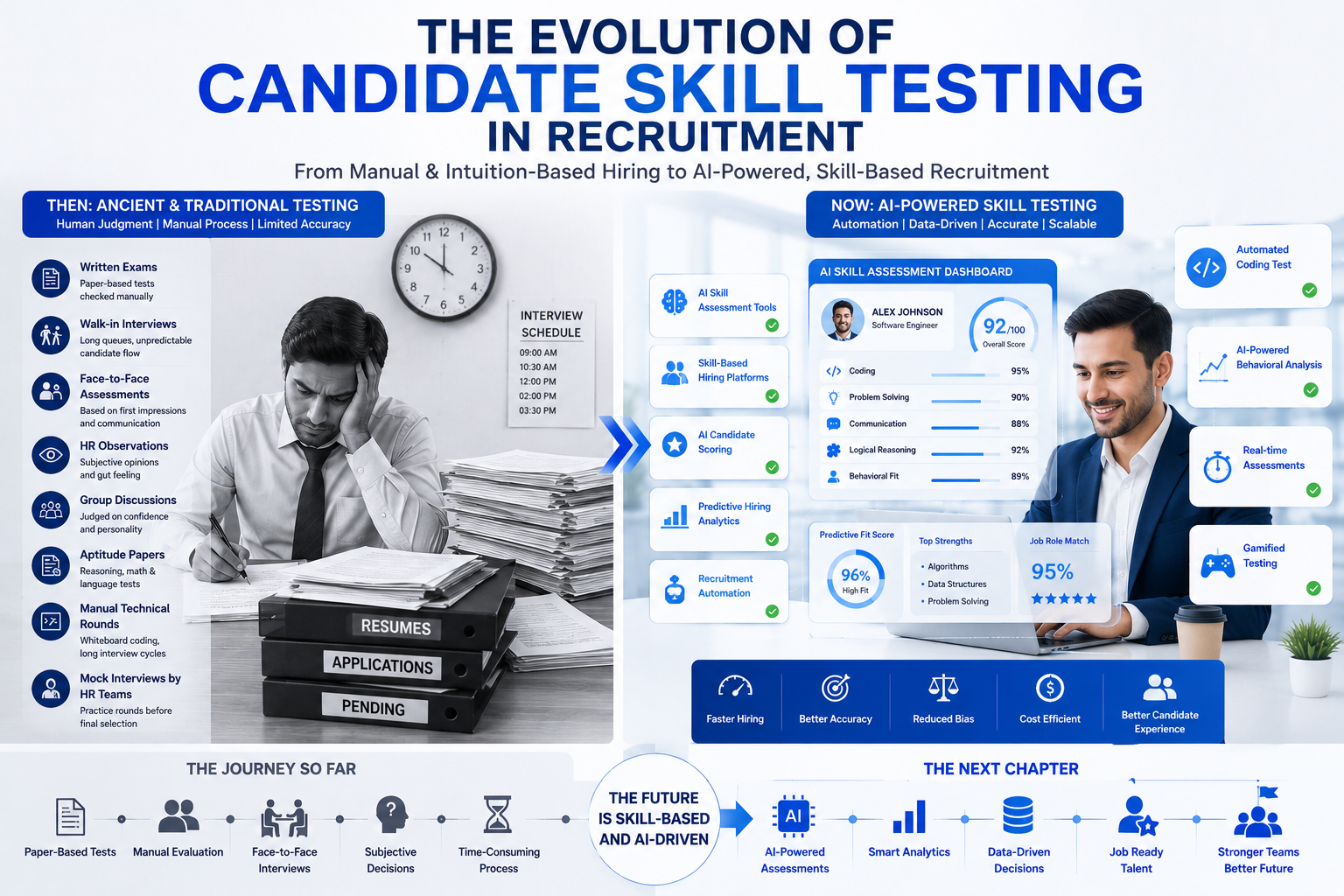
There was a time when getting hired felt less like a process and more like a test of patience, confidence, and luck.
Picture an old office building filled with nervous candidates holding folders tightly in their hands. Outside the interview room, dozens of applicants waited silently for their names to be called. Some revised aptitude formulas one last time. Others practiced answers in their heads, hoping they would impress the interviewer enough to secure the job.
Inside the room, HR managers sat across wooden desks, observing every movement carefully. A handshake, eye contact, communication style, resume formatting, or even dressing sense could influence hiring decisions.
This was the ancient world of recruitment.
Back then, companies believed they could identify talent through:
- Written exams
- Face-to-face interviews
- Group discussions
- HR observations
- Aptitude papers
- Walk-in interviews
- Manual technical rounds
- Mock interviews
Recruiters depended heavily on first impressions, confidence, educational degrees, and verbal communication rather than actual skill intelligence.
But recruitment has changed dramatically.
In 2026, companies no longer rely only on human judgment to evaluate candidates. Modern businesses now use AI skill assessment tools, automated coding tests, AI-powered behavioral analysis, and recruitment automation platforms to identify talent more accurately.
The evolution of candidate skill testing in recruitment represents one of the biggest transformations in hiring history.
Today, companies want proof of skills — not just polished resumes.
This shift from traditional hiring to skill-based hiring powered by AI is redefining how businesses recruit employees across India and the USA.
Ancient Recruitment and Traditional Skill Testing
The Early Era of Candidate Evaluation
In ancient recruitment systems, hiring was mostly manual and human-driven.
There were no AI recruitment tools, no automated assessments, and no intelligent analytics dashboards. Recruiters depended entirely on their own judgment.
Candidates were evaluated through traditional methods such as:
- Walk-in interviews
- Handwritten aptitude tests
- Face-to-face assessments
- Technical interviews
- HR observations
The hiring process focused more on personality and presentation than actual skills.
Written Exams and Aptitude Papers
One of the most common recruitment methods was written examinations.
Companies organized large hiring drives where candidates sat in examination halls solving:
- Aptitude questions
- Logical reasoning papers
- Mathematics tests
- English communication exams
Recruiters manually checked answer sheets and shortlisted candidates based on scores.
This process was extremely time-consuming.
Walk-In Interviews
Walk-in interviews were another major part of traditional recruitment.
Candidates traveled long distances carrying printed resumes and certificates just for a chance to meet recruiters.
Large companies often received hundreds of candidates in a single day.
Recruiters spent hours:
- Reviewing resumes
- Conducting basic interviews
- Shortlisting applicants manually
The process was exhausting for both recruiters and candidates.
Face-to-Face Assessments
Traditional hiring relied heavily on physical interviews.
Recruiters judged candidates based on:
- Confidence
- Communication skills
- Body language
- Personality
- First impressions
Although these factors mattered, they did not always reflect real job capabilities.
Many skilled candidates were overlooked simply because they were nervous during interviews.
Group Discussions and HR Observations
Group discussions became popular for evaluating:
- Leadership ability
- Communication skills
- Team collaboration
HR teams observed candidates closely and selected individuals who appeared more confident and expressive.
However, this system often favored extroverted personalities over genuinely skilled professionals.
Manual Technical Rounds
Technical hiring involved lengthy manual interviews.
Candidates solved problems on whiteboards or answered questions verbally while interviewers evaluated their responses manually.
The quality of evaluation depended entirely on the interviewer's personal expertise and judgment.
This created inconsistency in hiring decisions.
Problems with Manual Candidate Evaluation
Although traditional recruitment methods worked for decades, they had several limitations.
Human Bias in Recruitment
One of the biggest challenges was unconscious bias.
Recruiters often made decisions based on:
- College reputation
- Communication style
- Personality
- Resume design
- First impressions
This prevented many skilled candidates from getting fair opportunities.
Lack of Skill Accuracy
Traditional recruitment methods focused more on:
- Degrees
- Confidence
- Verbal communication
instead of practical job skills.
As industries evolved, companies realized that resumes alone could not accurately measure talent.
Slow Hiring Process
Manual candidate testing required:
- Physical coordination
- Interview scheduling
- Manual evaluations
- HR follow-ups
This increased time-to-hire significantly.
Fast-growing companies struggled to recruit talent quickly.
Inconsistent Candidate Evaluation
Different interviewers evaluated candidates differently.
Two recruiters could assess the same candidate completely differently based on personal opinions.
This inconsistency affected hiring quality.
High Recruitment Costs
Traditional hiring involved:
- Examination centers
- HR teams
- Office infrastructure
- Travel arrangements
- Administrative work
Recruitment became expensive and difficult to scale.
How Recruitment Testing Changed Over Time
As technology advanced, companies began modernizing recruitment processes.
Digital hiring platforms introduced:
- Online applications
- Virtual interviews
- Digital assessments
- Recruitment software
But the biggest transformation came with AI-powered recruitment automation.
Modern companies realized that skill-based hiring produces better employees than resume-based hiring.
This changed everything.
Rise of AI Skill Assessments
In 2026, AI skill assessment tools have become one of the most powerful innovations in recruitment.
Companies now use intelligent systems to evaluate candidates based on real abilities instead of assumptions.
What Are AI Skill Assessment Tools?
AI skill assessment tools use:
- Artificial intelligence
- Machine learning
- Recruitment analytics
- Behavioral analysis
to evaluate candidates automatically.
These systems can test:
- Technical skills
- Coding ability
- Communication
- Problem-solving
- Behavioral intelligence
- Role-specific competencies
within minutes.
Automated Coding Tests
Technology companies now use automated coding platforms to test developers in real time.
Instead of relying only on resumes, businesses assess:
- Programming logic
- Problem-solving ability
- Code quality
- Technical thinking
This creates more accurate hiring decisions.
AI-Powered Behavioral Analysis
Modern AI recruitment tools can also analyze behavioral patterns during interviews.
AI systems evaluate:
- Communication clarity
- Confidence levels
- Emotional intelligence
- Response quality
- Decision-making behavior
This helps recruiters understand candidates more deeply.
Real-Time Skill Assessments
Today, candidates can complete assessments remotely from anywhere.
AI-powered platforms conduct:
- Live technical tests
- Real-time evaluations
- Instant scoring
- Automated feedback
This improves hiring speed significantly.
Gamified Recruitment Testing
One of the latest trends in recruitment is gamified hiring assessments.
Instead of traditional aptitude papers, companies now use interactive games to evaluate:
- Critical thinking
- Creativity
- Decision-making
- Problem-solving speed
This makes recruitment more engaging for candidates.
AI Candidate Scoring and Predictive Hiring Analytics
AI systems now generate detailed candidate scores based on:
- Skill performance
- Behavioral insights
- Technical accuracy
- Communication ability
Predictive hiring analytics also help companies forecast:
- Job success probability
- Employee retention
- Performance potential
This improves recruitment accuracy dramatically.
AI vs Traditional Candidate Testing
Traditional Candidate Testing
Traditional recruitment focused on:
- Degrees
- Interviews
- HR observations
- Resume screening
- Verbal communication
The process was slower and more subjective.
AI-Powered Candidate Testing
Modern recruitment depends on:
- AI skill assessment tools
- Candidate assessment software
- AI recruitment automation
- Skill-based hiring platforms
- Predictive analytics
The process is faster, smarter, and more data-driven.
Benefits of AI-Powered Skill Testing
Faster Recruitment
AI assessments reduce hiring timelines dramatically.
Companies can evaluate thousands of candidates quickly.
Better Hiring Accuracy
Skill-based hiring identifies candidates based on real abilities rather than assumptions.
Reduced Human Bias
AI systems evaluate candidates using standardized criteria.
This creates fairer hiring decisions.
Improved Candidate Experience
Candidates receive:
- Faster feedback
- Remote assessments
- Flexible interview scheduling
- Smoother recruitment journeys
Scalable Recruitment
AI recruitment automation allows businesses to manage bulk hiring efficiently.
This is especially valuable for:
- IT companies
- BPO firms
- Startups
- Staffing agencies
- Ecommerce businesses
Why Companies Prefer Skill-Based Hiring in 2026
Modern businesses now understand that:
- Degrees do not guarantee skills
- Confidence does not always equal competence
- Resumes can be misleading
This is why skill-based hiring is becoming the future of recruitment.
Companies prefer candidates who can demonstrate:
- Real-world abilities
- Practical knowledge
- Technical expertise
- Problem-solving skills
AI recruitment tools make this evaluation easier and more accurate.
Future of Recruitment Assessments in 2030
The future of candidate testing will become even more intelligent.
By 2030, recruitment may include:
- Fully AI-driven hiring systems
- Real-time behavioral tracking
- Virtual reality assessments
- AI career simulations
- Personalized skill evaluation journeys
- Advanced predictive hiring models
Recruitment will focus more on:
- Verified skills
- Learning adaptability
- Cognitive intelligence
- Practical performance
The hiring world is moving toward intelligent talent evaluation systems.
Why Easy Hire Tools is Transforming Candidate Testing
Easy Hire Tools helps businesses modernize recruitment using advanced AI-powered hiring solutions.
The platform enables recruiters to automate skill testing and improve hiring accuracy efficiently.
Key Features of Easy Hire Tools
AI Skill Assessment Tools
Create customized assessments for technical and non-technical roles.
Candidate Assessment Software
Evaluate candidate performance using automated scoring systems.
Recruitment Automation
Streamline hiring workflows from screening to final selection.
AI Recruitment Tools
Use intelligent hiring technology to improve recruitment efficiency.
Predictive Hiring Analytics
Make smarter hiring decisions using data-driven insights.
Easy Hire Tools empowers recruiters, startups, staffing agencies, and enterprises to build future-ready recruitment systems.
Ready to Transform Your Recruitment Process?
Discover how Easy Hire Tools can help you build smarter hiring systems with AI-powered candidate assessments.
Get Started TodayFinal Thoughts
The evolution of candidate skill testing in recruitment tells the story of how hiring transformed from human intuition to intelligent talent evaluation.
In the ancient hiring era, recruiters depended heavily on resumes, interviews, first impressions, and confidence levels to judge candidates. Skill testing was manual, inconsistent, and often influenced by human bias.
But the recruitment industry evolved.
Today, AI skill assessment tools, recruitment automation, predictive hiring analytics, and candidate assessment software are helping companies identify real talent more accurately than ever before.
The future of hiring no longer belongs to resumes alone.
It belongs to skill-based hiring powered by AI.
Companies that embrace intelligent recruitment systems today will build stronger, smarter, and more capable teams for the future.
And platforms like Easy Hire Tools are leading this transformation by helping businesses hire based on skills, potential, and real performance — not just impressions.
FAQs
1. What is candidate skill testing in recruitment?
Candidate skill testing evaluates a candidate's practical abilities, technical knowledge, and job-related competencies during recruitment.
2. How did companies test candidates before AI?
Traditional companies used written exams, interviews, aptitude papers, group discussions, and HR observations.
3. What are AI skill assessment tools?
AI skill assessment tools use artificial intelligence to evaluate candidate skills automatically and accurately.
4. What is skill-based hiring?
Skill-based hiring focuses on a candidate's actual abilities instead of relying only on degrees or resumes.
5. How does AI improve recruitment testing?
AI improves recruitment through automation, accurate assessments, predictive analytics, and reduced hiring bias.
6. What is recruitment automation?
Recruitment automation uses AI and software tools to automate hiring tasks like assessments, screening, and scheduling.
7. What are gamified recruitment assessments?
Gamified assessments use interactive games to evaluate candidate problem-solving and cognitive abilities.
8. Why are companies adopting AI recruitment tools?
Companies use AI recruitment tools to improve hiring speed, reduce costs, and identify better talent.
9. What industries use AI skill testing?
Industries like IT, healthcare, ecommerce, BPO, finance, and staffing use AI skill assessment tools extensively.
10. What is predictive hiring analytics?
Predictive hiring analytics uses AI and historical data to forecast candidate success and retention potential.
11. How does candidate assessment software work?
Candidate assessment software automatically evaluates technical, behavioral, and role-specific skills using AI systems.
12. What is the future of recruitment testing?
The future includes AI-driven assessments, virtual simulations, predictive analytics, and personalized skill evaluation systems.