The sun was setting behind a massive ancient kingdom. Workers carrying stones for palace construction lined up outside the royal treasury, waiting for their wages. Some received bags of grain. Others got gold coins. A few were rewarded with livestock or pieces of land. The king's accountant sat beside giant paper scrolls, manually calculating payments based on loyalty, social status, and royal favor.
There were no salary structures. No payroll software. No compensation analytics.
Only human judgment.
Fast forward to 2026.
A global company now uses AI-powered systems that analyze millions of salary data points in seconds. Algorithms predict market salaries, identify pay gaps, recommend compensation strategies, and automate payroll across multiple countries instantly.
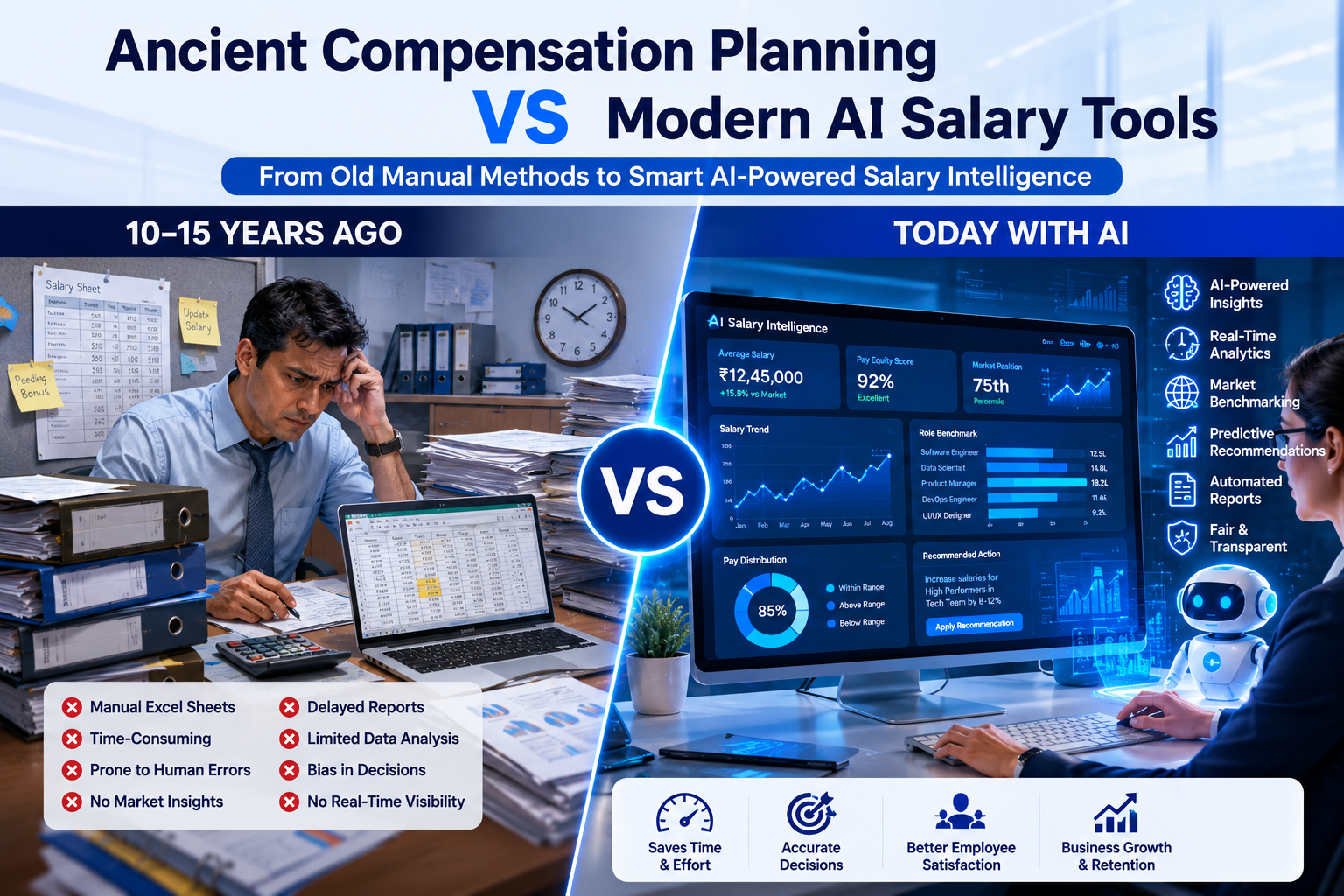
This dramatic transformation perfectly captures the story of Ancient Compensation Planning vs Modern AI Salary Tools. What once depended on instinct, handwritten records, and unequal decisions has evolved into intelligent, data-driven salary ecosystems designed for fairness, speed, and business growth.
The journey from ancient payroll scrolls to AI compensation engines is not just a technological shift. It is a revolution in how businesses value people.
How Compensation Planning Worked in Ancient Times
Long before corporations existed, compensation planning was already shaping societies.
In ancient kingdoms, rulers rewarded soldiers, farmers, craftsmen, and laborers through manual wage systems. Payments were rarely standardized. A merchant in one marketplace might pay workers in silver coins, while another landlord compensated laborers with crops, cattle, or shelter.
Inside royal courts, compensation planning depended heavily on hierarchy and personal relationships. Kings trusted royal accountants to maintain handwritten records of taxes, labor contributions, and rewards. But even these records were often inconsistent and incomplete.
Imagine the atmosphere of an ancient marketplace.
The sound of traders bargaining loudly. The smell of spices filling the air. Workers waiting anxiously to know whether their efforts would be recognized fairly. Compensation was deeply emotional because survival depended on it.
But traditional salary planning came with serious limitations.
There were no performance analytics. No market benchmarks. No transparent salary structures. Wages often depended on favoritism, political influence, or social class.
A skilled worker could earn less than someone less capable simply because of status or connections.
And because everything was managed manually, mistakes were common.
This ancient system may feel distant, but surprisingly, many early corporate payroll systems operated in very similar ways.
Problems with Traditional Compensation Planning
As civilizations evolved into businesses and industries, compensation planning remained largely manual for centuries.
Even during the early corporate era, HR departments relied heavily on paperwork, spreadsheets, and human calculations. Payroll teams spent endless hours checking employee salaries, bonuses, attendance, and tax deductions manually.
The result?
Human errors became unavoidable.
A misplaced decimal could impact hundreds of salaries. Delayed payroll processing created employee frustration. Bias influenced promotions and salary hikes. Managers often made compensation decisions based on opinions instead of performance data.
Transparency was another major issue.
Employees rarely understood how salaries were determined. This lack of clarity created distrust inside organizations. Many workers felt undervalued even when companies believed they were paying fairly.
For growing businesses, scaling compensation systems became a nightmare.
Imagine managing payroll manually for thousands of employees across multiple cities or countries. Different tax laws, inflation rates, and market salary expectations made traditional compensation planning extremely difficult.
In many ways, businesses were still behaving like ancient kingdoms — relying on fragmented systems and human judgment to decide employee worth.
The workplace was changing rapidly, but compensation management struggled to keep up.
Then technology entered the scene.
The Rise of Modern HR Technology
The late 1990s and early 2000s changed everything.
Businesses began replacing paper files with digital spreadsheets. Excel became the backbone of HR operations. For the first time, companies could organize salary data faster than handwritten ledgers.
But spreadsheets were only the beginning.
As organizations expanded globally, HR departments needed smarter systems. This demand gave birth to cloud-based HR platforms, payroll automation tools, and employee compensation software.
Slowly, compensation management transformed from an administrative burden into a strategic business function.
Companies started using digital dashboards to track salary trends, employee performance, retention rates, and hiring costs. HR teams no longer needed weeks to prepare compensation reports. Technology reduced workload and improved accuracy.
Then came artificial intelligence.
AI HR software introduced a completely new era of salary planning. Instead of simply storing payroll data, systems could now analyze, predict, and optimize compensation decisions in real time.
This was the turning point in the story of Ancient Compensation Planning vs Modern AI Salary Tools.
For the first time in history, businesses could use intelligence instead of intuition to manage salaries.
What Are Modern AI Salary Tools?
Modern AI salary tools are intelligent platforms designed to automate and optimize compensation planning using real-time data, analytics, and machine learning.
Think of them as digital compensation strategists working 24/7.
Unlike traditional salary planning systems, AI compensation planning tools analyze massive datasets instantly. They evaluate market trends, employee performance, geographic salary differences, inflation patterns, skill demand, and industry benchmarks simultaneously.
The result is smarter, faster, and fairer compensation decisions.
Today's AI salary management software can help businesses:
- Benchmark salaries against competitors
- Detect unfair pay gaps
- Predict future compensation trends
- Automate payroll calculations
- Create personalized salary structures
- Improve employee retention strategies
For example, salary benchmarking software can instantly compare a software engineer's salary in Mumbai with similar roles in New York, Bangalore, or London.
AI payroll systems can process salaries for thousands of employees within minutes while reducing manual errors dramatically.
Modern compensation management is no longer about basic payroll processing. It is about understanding workforce value through data intelligence.
And this intelligence is becoming a competitive advantage.
Ancient Compensation Planning vs Modern AI Salary Tools
The contrast between ancient compensation methods and modern AI systems feels almost cinematic.
An ancient accountant once spent days calculating payments manually using paper scrolls and verbal agreements.
Today, an AI engine processes millions of salary records in seconds.
Ancient systems depended on memory, hierarchy, and instinct.
Modern AI salary tools depend on data, automation, and predictive intelligence.
Here is how the transformation looks:
Speed
Ancient payroll systems were painfully slow. Modern AI compensation planning tools deliver real-time salary calculations instantly.
Accuracy
Manual systems created frequent payroll mistakes. AI salary management software minimizes human error through automation.
Fairness
Ancient wage systems favored power and social status. AI-driven systems focus on performance metrics, market standards, and pay equity.
Transparency
Traditional salary planning lacked visibility. Modern platforms provide employees with clearer compensation structures and analytics.
Data Analysis
Ancient rulers relied on assumptions. AI tools analyze millions of workforce data points to guide compensation strategies.
Employee Satisfaction
Delayed or unfair wages created dissatisfaction in ancient and early corporate systems. Modern employee compensation software improves trust and retention through consistency and fairness.
Business Scalability
Managing compensation manually becomes impossible at scale. AI HR software helps companies handle global payroll operations efficiently.
The difference is not just technological.
It is philosophical.
Ancient systems asked, "What should we pay this worker?"
Modern AI asks, "What is the smartest, fairest, and most strategic compensation decision for both the employee and the business?"
That shift changes everything.
How AI Salary Tools Help Modern Businesses
Today's businesses operate in a world where talent competition is intense.
Employees compare salaries online. Skilled professionals expect transparency. Startups compete with global corporations for top talent.
In this environment, outdated payroll systems create major risks.
AI salary tools help businesses stay competitive by making compensation planning faster, smarter, and more strategic.
For startups, AI compensation planning tools reduce administrative burden and improve hiring confidence. Small HR teams can make data-driven salary decisions without needing large payroll departments.
For enterprises, AI payroll systems simplify complex global compensation structures. Companies managing remote teams across different countries can automate payroll while staying compliant with local regulations.
Recruitment agencies use AI salary management software to recommend competitive salary packages based on real-time market data.
Businesses also benefit from:
- Reduced payroll errors
- Faster salary approvals
- Better workforce planning
- Improved employee retention
- Equal pay practices
- Stronger employer branding
In many organizations, compensation planning has shifted from being an HR process to becoming a growth strategy.
And businesses that ignore this shift risk falling behind.
The Future of Compensation Planning
The future of compensation planning looks even more fascinating.
Soon, AI-driven salary systems may predict employee dissatisfaction before resignations happen. Compensation platforms could automatically recommend salary adjustments based on market demand, employee performance, and economic conditions in real time.
Blockchain payroll systems may bring unmatched transparency and security to global salary payments.
Personalized compensation structures could become normal, where employees choose customized combinations of salary, bonuses, wellness benefits, remote work allowances, and learning incentives.
The future of compensation planning will likely become deeply connected with predictive intelligence.
Imagine an AI system that tells a company:
"If you increase salaries for this department by 8% now, employee retention may improve by 32% over the next year."
That future is closer than most businesses realize.
The companies embracing AI compensation systems today are preparing themselves for the workforce of tomorrow.
Conclusion
The story of Ancient Compensation Planning vs Modern AI Salary Tools is ultimately the story of human progress.
From ancient kings distributing grain in crowded marketplaces to AI-powered enterprises analyzing global salary trends in seconds, compensation planning has undergone an extraordinary transformation.
What once depended on intuition, hierarchy, and handwritten records now runs on intelligence, automation, and predictive analytics.
But the goal remains the same.
People want to feel valued for their work.
The tools have changed. The technology has evolved. The speed is unimaginable compared to ancient systems. Yet compensation planning still sits at the heart of every successful workforce.
Businesses that continue relying on outdated methods may struggle in the future.
Meanwhile, organizations adopting AI salary management software, payroll automation tools, and intelligent compensation platforms are building workplaces that are faster, fairer, and more competitive.
The future belongs to businesses that understand one powerful truth:
Compensation planning is no longer just about paying employees.
It is about understanding human value through intelligent technology.